
Separation is never easy. And when children are involved, it can feel even harder, especially when you and your ex just can’t seem to agree on something as important as when the kids will see each of you. You’d prefer a calmer, more respectful process
If you’ve found yourself Googling “child access mediation UK” at midnight, feeling anxious and unsure where to turn, you’re not alone. Thousands of parents across England and Wales are in exactly the same position right now. The worry is real, the stakes are high, and the situation can feel overwhelming.
The good news? There’s a better way forward than heading straight to court. It’s called Child Access Mediation UK Maidenhead, and for many families in the UK, it’s been a genuine turning point.
In this guide, we’re going to walk you through everything you need to know, from what mediation actually is to how the process works step by step, what you can agree on, what it costs, and when it’s the right (or wrong) option. No legal jargon. No confusing acronyms without explanation. Just clear, honest information to help you understand all your options around this and take the next step with confidence.
Here’s exactly what we’ll cover:
- What child access mediation UK actually is (and what the law calls it now)
- How the process works from your first meeting to a written agreement
- What you and the other parent can agree on, from living arrangements to holidays
- Why mediation often works better than going to court
- How much it costs in the UK, and how to get help with the fees
- Honest answers to the questions real parents are asking online
What Is Child Access Mediation Maidenhead?

Let’s start at the very beginning.
Child access mediation UK Maidenhead, also referred to as child arrangements mediation or family mediation, is a structured, guided process in which a trained, independent mediator helps separated or divorcing parents reach an agreement about their children’s lives.
Think of the mediator as a calm, neutral guide: someone who helps both of you have productive conversations that might be impossible to have on your own, especially when emotions are running high.
One important thing to know first: the term “child access” is the older, more familiar way of describing it
The UK legal system now uses the phrase child arrangements, which covers:
- Where your children live is sometimes called “residence”
- How much time they spend with each parent, sometimes called “contact” or “visitation”
- How key decisions about their upbringing are made
But don’t worry if you’re searching for “child access mediation,” “child contact mediation,” or “child arrangements mediation”, it’s all the same process. And if you’re reading this guide, you’re already asking the right questions.
Here’s what a mediator is not: they’re not a judge, they won’t make decisions for you, and they won’t take sides. Their job is to help both parents stay focused on what really matters, your children’s wellbeing, and guide you towards workable, practical agreements that your family can actually live with
How Does Child Access Mediation UK, Maidenhead Work? A Step-by-Step Guide
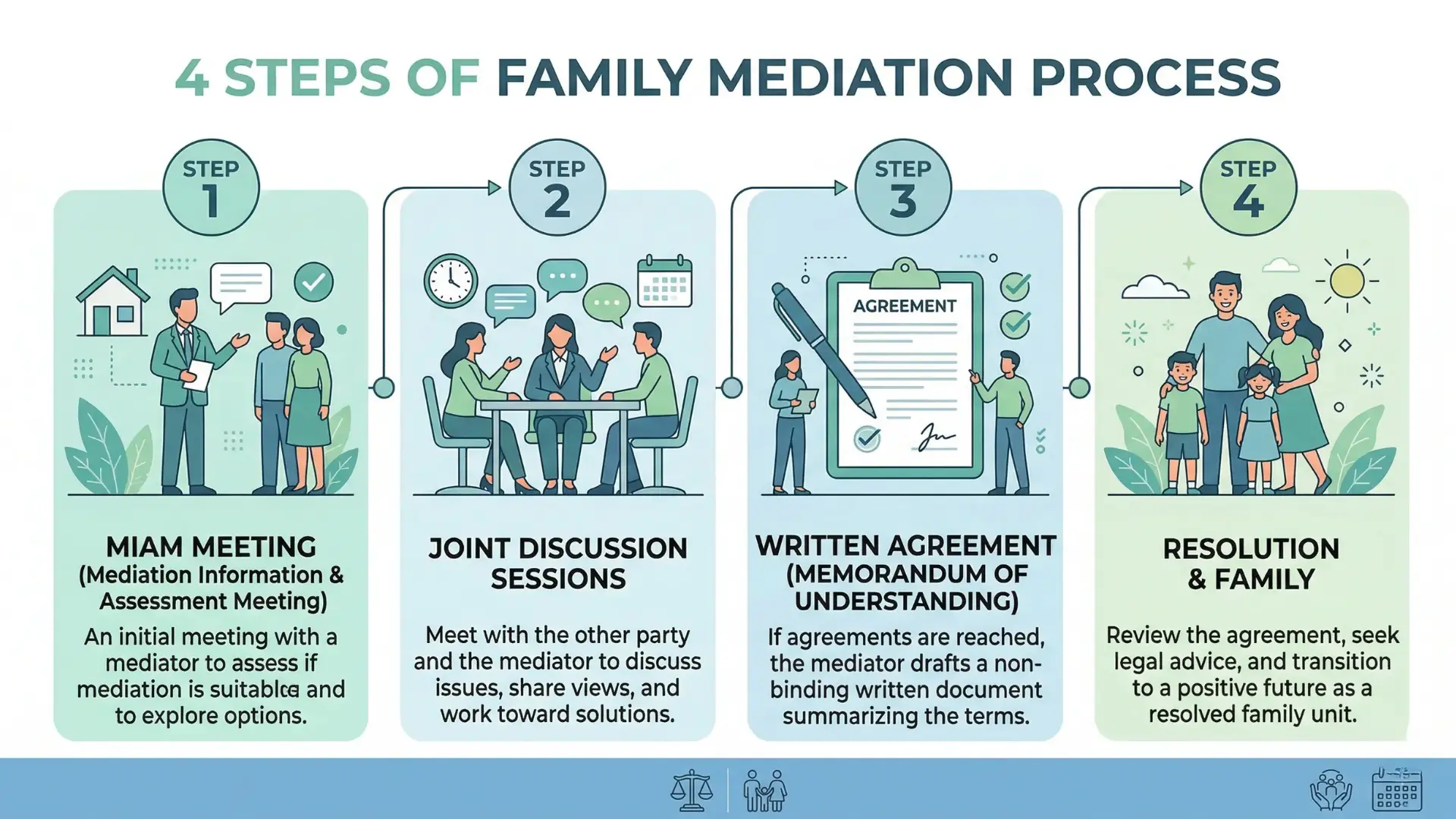
If you’ve never been through child access mediation UK before, the process can feel mysterious or even daunting. So let’s break it down clearly, step by step, so you know exactly what to expect at every stage.
Step 1: The MIAM : Your Starting Point Maidenhead
Before anything else, you’ll attend something called a MIAM : a Mediation Information and Assessment Meeting. This is a private, one-to-one meeting with a trained mediator. Your ex attends their own separate MIAM, so there’s no awkward confrontation at this stage.
The MIAM usually lasts around 45 minutes and gives you the space to:
- Tell the mediator about your situation, in your own words, without your ex present
- Learn how mediation works and what you can realistically expect
- Ask any questions you have, however basic they might feel
- Discuss whether there are reasons mediation might not be suitable (such as safety concerns)
Key fact: In most cases, attending a MIAM is a legal requirement before you can apply to a family court for a child arrangements order. Since April 2014, the courts have required that mediation be properly considered before they will accept most applications. Your mediator will sign a MIAM certificate that you’ll need if court proceedings become necessary.
Step 2: Joint Mediation Sessions
If both parents agree that mediation is worth trying, you move on to joint sessions. These are structured, guided conversations, usually held in the same room as your ex, or in some cases in separate rooms if that feels safer or more appropriate (this is called shuttle mediationMaidenhead).
Sessions typically last between one and two hours. Most child arrangement cases reach agreement within two to three sessions, meaning the whole process usually takes just a few weeks, or a couple of months at most. Compare that to six to twelve months if the same matter goes through the family court.
During sessions, you’ll talk through the issues that matter most: things like where the children will live, how contact is arranged, holidays, routines, and anything else relevant to your family. The mediator keeps things productive, ensures both voices are heard, and helps redirect conversations when they become unhelpful.
Step 3: Reaching an Agreement
If you finally reach an agreement, the mediator writes it up as a Memorandum of Understanding, a clear, detailed written document summarising what you’ve both agreed. Each parent receives a copy, and children genuinely benefit from the stability and certainty this kind of written plan provides.
This document isn’t automatically legally binding, but it can be converted into a Consent Order through the courts if you want it to have the full force of law. Many families choose not to take this additional step, but it’s a straightforward option if you need that extra reassurance.
Step 4: If Agreement Isn’t Reached
Mediation doesn’t always end with a complete agreement, and that’s okay. If you can’t reach a resolution, the mediator issues an FM1 certificate confirming you’ve attempted mediation. You’ll need this to make a court application. Importantly, even partial agreements reached during mediation can reduce what a judge ultimately needs to decide, saving you time, money, and stress.
What Can Parents Agree on in Child Access Mediation Maidenhead?

This is one of the most important things to understand: child access mediation UK in the Maidenhead covers far more than just “where does the child sleep on which night.” It can help parents reach agreement on a whole range of everyday and longer-term decisions that shape their children’s lives.
Here’s a breakdown of the key areas mediation can help you agree on:
Where the Children Will Live
- Whether children will primarily live with one parent, or whether time will be split between both homes
- Whether a shared care arrangement, where children spend roughly equal time with each parent, is right for your family
- Practical handover arrangements: how, when, and where children move between homes
See our detailed, simple, and in-depth guides on Child Maintenance
Contact and Visiting Schedules
- Regular weekday and weekend contact for the non-resident parent
- Overnight stays and extended stays
- Half-term and school holiday arrangements
- Christmas, Easter, and other key dates, including birthdays and bank holidays
- Special occasions such as Mother’s Day, Father’s Day, and family events
Day-to-Day Routines
- School pick-up and drop-off responsibilities
- After-school clubs, activities, and appointments
- Medical and dental appointments: who attends, how decisions are made
- How parents communicate with each other going forward: by text, co-parenting app, or email
Bigger Life Decisions
- School choice and educational decisions
- Religious upbringing
- Holidays abroad, notice required, consent processes, and passport arrangements.
- What does it mean if one parent wants to move to another area of the UK or abroad?
The wonderful thing about child access mediation UK is that you and the other parent draft the agreement together, based on your family’s unique needs and situation. There is no one-size-fits-all solution, and because you both helped de
Read the Child Arrangements Guide to Understand this in detail.
Why Does Child Access Mediation Maidenhead Work? (And Why It’s Often Better Than Court)

You might be thinking: “Can’t we just let a solicitor sort this? Or let the court decide?” You absolutely can. But before you go down that road, it’s worth understanding what that involves, and why most families, even those who start out in serious disagreement, find that mediation is a genuinely better route.
It’s Much Quicker :
Going through the family court system for child arrangements can take anywhere from six months to well over a year. Courts across England and Wales are under significant strain, and delays are common. Mediation, by contrast, typically takes two to three months from your first MIAM to a written agreement. When your children are living with uncertainty, every week that passes matters.
It’s Significantly Cheaper:
Court proceedings for child arrangements can easily cost several thousand pounds in solicitor fees, court fees, and other expenses. The average child access mediation UK session in Maidenhead costs around £140 per hour, and government funding of up to £500 is available for child arrangement cases. Total mediation costs are often a fraction of what the court process would cost you.
You Stay in Control :
In court, a judge makes the final decision, and neither of you chose it. The outcome might not reflect the reality of your family’s life, and you’re both stuck with it regardless. In mediation, you and your ex make the decisions. That means the arrangement is far more likely to fit your children’s real needs and your actual day-to-day circumstances.
It Protects Your Children from Conflict :
Kids are affected viscerally by parental conflict. Genaedics: Research has repeatedly shown that children fare better after separation when their parents can work together and communicate, even if their relationship is difficult. With mediation, the focus is on collaborative problem-solving, not blame and confrontation. This helps shield your children from ongoing parental conflict that can cause enduring damage.
It Builds Better Long-Term Communication :
Even if your relationship with your ex is difficult right now, the skills developed in child access mediation UK, listening, compromising, and focusing on your children rather than your grievances, genuinely help build better communication patterns for the future. Many parents who go through mediation find that talking about the kids becomes far easier in the months and years that follow.
Agreements Last Longer :
Because you’ve both chosen the arrangement, mediated agreements tend to be respected and observed for longer than court-imposed orders. And crucially, mediation gives you the flexibility to revisit and adapt arrangements as your children grow and circumstances change, without having to go back to court every time.
The biggest difference? The court tends to turn things into a fight. Mediation tries to turn it into a conversation.
Or you can simply ask us more by calling us for free to know more about child access mediation UK in Maidenhead. We are just a ring away :
Who Can Use Child Access Mediation UK, Maidenhead?

Child Access Mediation UK is open to any parent or carer who is separated or separating and needs help reaching an agreement on arrangements for their children. This includes:
- Married couples going through a divorce
- Unmarried couples who have separated
- Same-sex couples
- Grandparents or other extended family members seeking to maintain contact with a child
- Parents with one party living in another part of the UK or overseas
The most important point in mediation is that both parties must be open-minded and intent on resolving the dispute. It’s not appropriate in every context.” For instance, in a case of serious domestic abuse concerns, where there is an important power imbalance or if one parent outright refuses to participate in the process, mediation does not make sense.
There are specific legal exemptions to the MIAM requirement, including cases involving domestic abuse (where evidence exists), urgent safeguarding situations, or where mediation has already been attempted within the last four months. A qualified mediator will assess your individual situation carefully at your MIAM, and there’s no pressure to proceed if mediation isn’t right for you.
How Much Does Child Access Mediation Cost in the Maidenhead, UK?

Cost is one of the most common concerns parents raise when considering mediation, and understandably so. Here’s a clear, honest breakdown of what you can expect.
Typical Mediation Session Costs
The Family Mediation Council recently reported that the average child access mediation UK cost is approximately £140 per hour, though this can vary between providers and across different areas of the country. The cost of an MIAM typically ranges from £90 to £150. The average child arrangement case typically requires between two and three full rounds of mediation, bringing total costs into the range of £400 to £900. That’s far less than what court proceedings usually cost, often by thousands of pounds.
The Government Family Child Access Mediation UK Voucher Scheme
In March 2021, the UK government launched the Family Child Access Mediation UK Voucher Scheme to help more parents access mediation to resolve their disputes outside the courts. If your case involves child arrangements, you may be eligible for up to £500 towards the cost of mediation sessions. Importantly, this scheme is not means-tested; your income level doesn’t determine whether you qualify. The mediator you assign can advise you on eligibility and assist you with your application.
Legal Aid for Mediation For Child Access Mediation UK, Maidenhead
If you’re on a low income or receiving certain benefits, you may qualify for Legal Aid to cover your mediation costs. For eligible individuals, mediation can be entirely free. It’s well worth checking your eligibility before assuming mediation is financially out of reach. Many parents are surprised to find they qualify.
Frequently Asked Questions About Child Access Mediation UK Maidenhead

These are the questions about child access mediation UK, real parents are searching for online, in forums, Reddit threads, Quora discussions, and parenting communities across the UK. We’ve answered each one honestly, in plain English, without the legal waffle.
Q. Can my ex refuse to go to mediation?
Yes, child access mediation in the UK is a voluntary process, and no one can be compelled to attend. However, if your ex declines and you later need to apply to court, their refusal will be on record. Judges take a dim view of parents who haven’t made reasonable efforts to resolve matters outside court. Your mediator will contact your ex directly to explain the process and invite them to a separate MIAM.
Q. Do I have to attend a MIAM before going to court?
In most cases, yes. Since April 2014, attending a MIAM has been a legal requirement before making most applications to the family court regarding children. Exemptions include cases involving domestic abuse (where evidence exists), situations of urgency, and where mediation has already been attempted in the past four months
Q. Is child access mediation UK in Maidenhead legally binding?
Not automatically. Agreements are written up in a Memorandum of Understanding: a clear, detailed document that both parents receive. It only becomes legally enforceable if converted into a Consent Order, which requires a brief court approval process. A family solicitor can help you apply for one if needed.
Q. What if there’s been domestic abuse? Can we still do mediation in Maidenhead?
Safety is always the priority. If there has been domestic abuse, you are not required to attend a MIAM, provided you have supporting evidence, such as a letter from a GP or a copy of a protective court order. In some lower-risk cases, shuttle mediation, where parties remain in completely separate rooms, may be considered, always with your safety at the forefront. So there are no such issues to be faced in such cases as described in this child access mediation UK
Q. Is the mediation process confidential?
Safety is always the priority. If there has been domestic abuse, you are not required to attend a MIAM, provided you have supporting evidence, such as a letter from a GP or a copy of a protective court order. In some lower-risk cases, shuttle mediation, where parties remain in completely separate rooms, may be considered, always with your safety at the forefront.
Q. How long does child access mediation UK take in the Maidenhead?
A MIAM typically takes around 45 minutes. Full mediation sessions run between one and two hours each. Most child arrangement cases are resolved within two to three sessions, meaning the whole process usually takes between two and three months. This contrasts sharply with family court proceedings, which can take six to twelve months or longer.
Q. Can my child’s views be included in mediation?
Yes. Many services offer Child-Inclusive Mediation, in which a specially trained mediator meets the child separately, with both parents’ consent, to understand the child’s feelings. Children are never asked to choose between parents. The mediator gently gathers their views and conveys them to parents in a way that informs the agreement. Around 70% of child-inclusive child access mediation cases in the UK reach a satisfactory resolution.
Q. What happens if we can’t reach an agreement in mediation?
That isn’t a failure, and it doesn’t close off your options. Your mediator will issue an FM1 certificate confirming mediation was attempted, which you’ll need to make a court application. Any partial agreements reached can still be useful; they reduce the number of issues a judge needs to decide, saving time and money
Ready to Take the Next Step?
If you’ve read this far, you’re already doing the right thing. You’re educating yourself, exploring your options thoughtfully, and putting your children’s needs at the centre of your thinking. That matters enormously.
Child access mediation UK in the Maidenhead, UK offers a real, practical way forward — one that is quicker, cheaper, and far less damaging to your family than court proceedings.
It keeps you in the driving seat throughout the whole process of the child access mediation UK. It protects your children from prolonged conflict. And it gives you the space to create an arrangement that actually reflects your family’s life, not a one-size-fits-all court order.
At National Mediation Helpline, we work with families across the UK every day, helping parents navigate child arrangements mediation with care, clarity, and compassion. Whether you’re still weighing up your options or you’re ready to book a MIAM today, we’re here to help — without judgement, without jargon, and without pressure.
Get in touch today to speak with one of our trained mediators and anything for the child access mediation Uk in Maidenhead. Your first step towards a calmer, clearer future for your family.