
When you do not have an agreement about your child, it could appear that the one door that you were told to attempt has just shut when mediation breaks down. It hasn’t. However, where they go after mediation depends on how it ended, and most guides miss that nuance entirely.
So If you are at Child Arrangements Mediation Failed What Next Maidenhead, Then You are at the Right Place. We also wish that your kid gets everything from the family.
In the UK, whether your child’s arrangements mediation fails and what to do next depends on whether the process got stuck on just one sticking point, if one of the parties dropped out or if a mediator felt that the case was wrong for mediation in the first place. Any one of those takes you somewhere just a little different.
If you do this right the first time, you save yourself months.
Something to say straight off the bat, before anything else: mediation failure will not mean you are at fault. Nor does it mean the court is all that remains. A lot of families never agree in mediation but then reach an agreement later, sometimes with a single piece of advice, sometimes after a break, and at other times even with a different mediator.
The Three Ways Mediation Can End Without Agreement
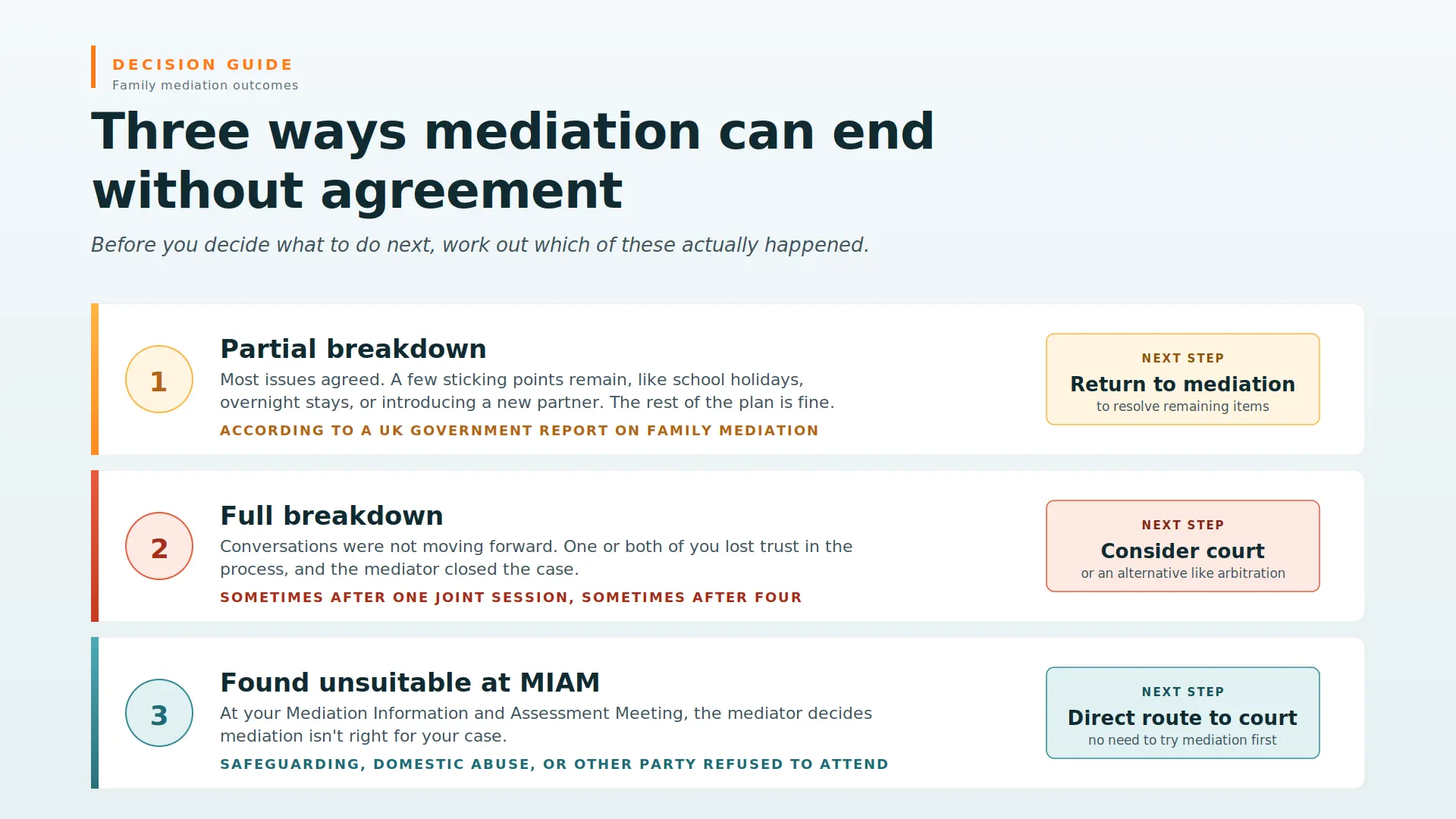
Before you decide what to do next, work out which of these actually happened.
A partial breakdown in mediation can happen when most issues are agreed upon but disagreements remain on specific topics such as school holidays, overnight stays, or introducing a new partner, according to a UK government report on family mediation Maidenhead. The rest of the plan is fine.
The second is a full breakdown. The conversations weren’t moving forward, one or both of you lost trust in the process, and the mediator closed the case. Sometimes this happens after one joint session, sometimes after four.
Even the online Mediation Maidenhead Can Help You , Read Here How.
The third is that mediation was found to be unsuitable. This is different. At your MIAM Maidenhead (Mediation Information and Assessment Meeting), the mediator may decide mediation isn’t right for your case, often because of safeguarding concerns, a history of domestic abuse, or because the other party refused to attend. You don’t need to “try” mediation in this situation to move forward.
Each of these has a different best next step. Jumping straight to a court application when you’re actually dealing with a partial breakdown is how people end up paying huge court fees they didn’t need to pay. Before you think court is the answer to the child arrangements mediation failed what next, then think again.
When Mediation May Not be Suitable Maidenhead

Mediation needs two things to work: both people willing to take part, and a reasonable ability to have a safe conversation. If either is missing, no amount of good intent from either side will force it.
Common reasons mediation is assessed as unsuitable include:
- A history of domestic abuse, coercive control or intimidation between the parties
- Safeguarding concerns about a child
- One party refuses to attend or engage with the MIAM.
- Power imbalances that make open discussion impossible (even with shuttle mediation, where mediators pass messages between parties in separate rooms)
- Ongoing police involvement or live court proceedings affecting the same issues
Where any of these apply to you, the mediator will provide either an MIAM certificate or one of the exemptions lists showing that mediation is not suitable for your case. That paperwork gives you the ability to start court proceedings without the expectation of first attempting mediation.
Read Full Guide on What Can Be Agreed on Child Arrangements Agreements and What CAN’T
What Happens Next If You Go To Maidenhead Court
If mediation has genuinely reached the end of the road, the route to court is as follows.
You will complete a C100 form to submit to the family tribunal. This is a Child Arrangements Order application, which determines where your child lives and how they will spend time with each parent (can be made by the court). It also encompasses Prohibited Steps Orders preventingr preventing one of the parents from doing such a specific thing, such as taking a child out of the country) and Specific Issue Orders (self-such as planatory: that establishes how to resolve a specific disagreement, such as which school a child attends).
In respect of C100, the fee is currently around £263 and can be applied for either online via gov.uk or via post. If you are on some benefits or have a low income, you could apply using form EX160 for Help with Fees, which may eliminate the costs entirely or reduce them.
Here’s a quick comparison of the three orders the C100 covers:
| Child Arrangements Order | Where the child lives and when they see each parent | The main order when you can’t agree on contact or residence |
| Prohibited Steps Order | Stops a parent from doing something specific | Often used to prevent international relocation without consent |
| Specific Issue Order | Resolves a particular dispute about upbringing | Schooling, medical treatment, religious upbringing |
Once your C100 is submitted, your first hearing (called the FHDRA, or First Hearing Dispute Resolution Appointment) usually takes place within 5 to 6 weeks. A reasonably contested case typically reaches a final decision within 8 to 12 months, though cases involving safeguarding assessments or fact-finding hearings can take considerably longer.

HASSLE FREE – BEST WAY FORWARD
How the National Mediation Helpline Maidenhead can help
If your first attempt at mediation has stalled, the most useful thing you can do next is talk to someone who can tell you honestly which route above best fits your situation. That’s what we do. We’ll look at what happened, what’s blocking agreement, and whether another form of mediation, a solicitor-led conversation, or direct court application makes more sense for you.
You can book a free consultation with National Mediation Helpline to talk it through. There’s no charge for the initial call, and no pressure to proceed with anything afterwards.
Cafcass (Children and Family Court Advisory and Support Service) will do safeguarding checks with the police and local authority before the first hearing. If they do speak to you, they may also talk to your ex-partner and, in some circumstances, your child.
What a Child Arrangements Order Maidenhead Actually Sets Out

A Child Arrangements Order, Maidenhead is not some nebulous operating procedure. It is particular, and if conferred, both parties must perform or face enforcement.
The order typically covers:
- The parent the child resides with, or how time is divided between both homes.
- The days, times and means of handover contact
- How do you divide school holidays or special occasions.
- Direct (in-person) or indirect (phone, video calls, letters and so on) contact.
- If supervision is required, who provides it and where
- The procedure for agreeing on variations in the arrangement
The starting point for the Court is a consideration of what is in the best interests of the children. According to a House of Commons Library report, the law in England and Wales generally presumes that it is in a child’s best interests to have contact with both parents, but this only applies if involvement does not put the child at risk of significant harm. This will certainly help you in the case of child arrangements mediation failed what next.
Choices other than mediation and not the courtroom
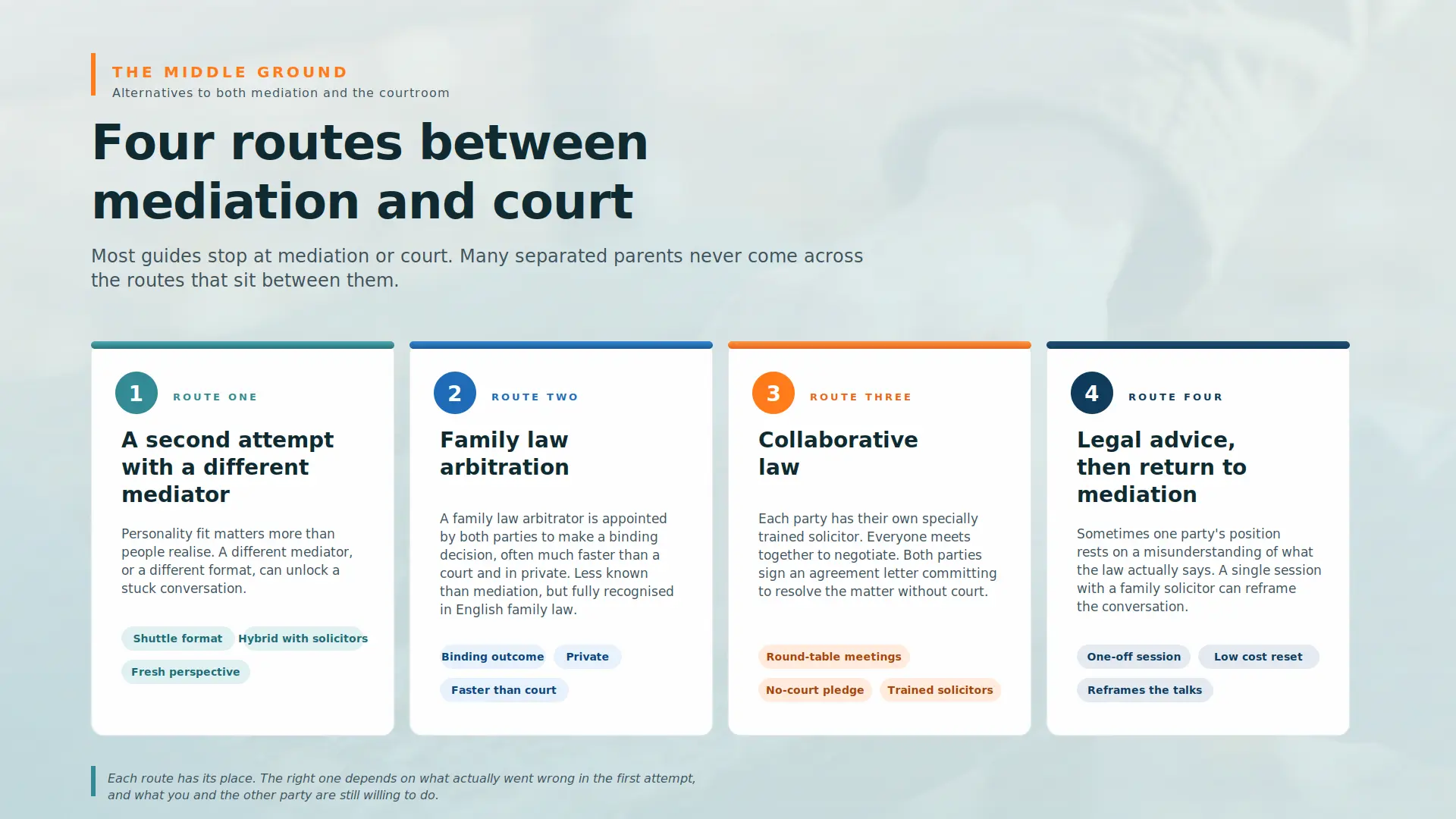
Most guides will stop here. It shouldn’t. Many separated parents never come across the routes that sit between mediation and a contested court application.
- A second attempt at mediation with a different mediator. Sometimes the personality fit matters more than people realise. A different mediator, or a different format (shuttle mediation, hybrid mediation with solicitors present), can unlock a stuck conversation.
- Arbitration. A family law arbitrator is appointed by both parties to make a binding decision, often much faster than a court and in private. It’s less well-known than mediation but fully recognised in English family law.
- Collaborative law. Each party has their own specially trained solicitor, and everyone meets together to negotiate. Both parties sign an agreement letter committing to resolve the matter without a court.
- Independent legal advice followed by a return to mediation. Sometimes one party’s position is based on a misunderstanding of what the law actually says. A single session with a family solicitor can reframe the conversation enough to get mediation back on track.
Were you denied access to your own child, this guide may help you in a perfect way.
What to do this week
If you take one thing from this article, let it be this: the version of “mediation failed” in your case probably isn’t the same as the version in someone else’s. The single most useful thing you can do before spending money on a court application is to work out which kind of breakdown you’re actually dealing with, and whether there’s a smaller, cheaper next step that could still get you an agreement.
At National Mediation Helpline Maidenhead, We help you in every way possible, we try as hard as you are trying right now. Just a consultation sometimes, may be a call of destiny, can help you the way, you never imagined. That’s why we always say “Hope is not a strategy”, “Planning is.”
If you’re not sure, get in touch with the National Mediation Helpline for a short, honest conversation about your options.
FAQs : Child Arrangements Mediation Failed What Next Maidenhead

What if mediation does not work in the UK?
A signed MIAM certificate stating that mediation was tried or is inappropriate. You can apply for a Child Arrangements Order at the family court by filling in the C100. The court fee is currently set at £263. Help with Fees exists if you’re on a low income
Is there an ability to appeal a Child Arrangements Order in the UK?
Yes, but you must have permission, which will usually be granted only if there is an error of law, a serious procedural flaw, or new evidence that was not available at the original hearing. You normally have 21 days from the date of the order to file an appeal. Talk to a family solicitor before doing this.
Am I able to contact my son even after being in a Divorce with my ex?
In legal terms, yes, providing you both have parental responsibility. In reality, then, if your ex wants non-contact, it is mediation or a lawyer’s letter, and if you cannot agree via these, it becomes a Child Arrangements Order to make contact formal. Call the cops right away if that kid is risking their life.
After the mediation attempt fails, what happens next?
Of course, a C100 application to the family court, but not an exclusive route. You can also consider arbitration, collaborative law, a different type of mediation (shuttle or hybrid), or legal advice followed by another round of mediation, depending on why the first round did not work.
How long is it before you can file for court after mediation?
If, during those 12 months, you were to apply to the court, there’s no requirement for another MIAM. Normally, you will need to do another MIAM again in four months before the court will accept your C100.
What if mediation fails, again?
The mediator will close the case and issue a certificate stating mediation has ended. You can then bring a C100 application to court with that certificate for up to four months. If you leave it until later, you usually need another MIAM before making an application.