
If you’re going through a separation or family dispute, things can quickly feel overwhelming—emotionally and financially. That’s where the Family Mediation Voucher Scheme (FMVS) comes in.
In simple terms, it’s a government-backed initiative designed to make family mediation more accessible and affordable. Instead of heading straight into costly and stressful court proceedings, this scheme encourages families to resolve issues through mediation—with financial support to help cover the cost.
The voucher contributes (not a full payment) towards mediation sessions. It’s especially helpful for disputes involving children, but it can also apply to financial matters in certain situations.
The goal is straightforward: help families communicate better, reach agreements faster, and avoid unnecessary court battles.
How to Apply for a Family Mediation Voucher Step-by-Step
Applying for a Family Mediation Voucher scheme isn’t something you do alone—it’s handled through a qualified mediator. See Here: Can Divorce Mediation Help You Avoid Court Battles Maidenhead?
Here’s how the process usually works:
Step 1: Book a MIAM (Mediation Information and Assessment Meeting)
This is your starting point. A mediator will assess your situation and explain whether mediation is suitable.
Step 2: Mediator checks eligibility
If your case meets the criteria (especially if children are involved), the mediator will determine if you can access the voucher.
Step 3: The mediator applies on your behalf
You don’t need to fill out complicated forms. Your mediator submits the application directly to the scheme.
Step 4: The voucher scheme is approved
Once approved, the funding is allocated and used towards your mediation sessions.
Step 5: Begin mediation sessions
You can now focus on resolving your issues, knowing some of the financial pressure has been reduced.
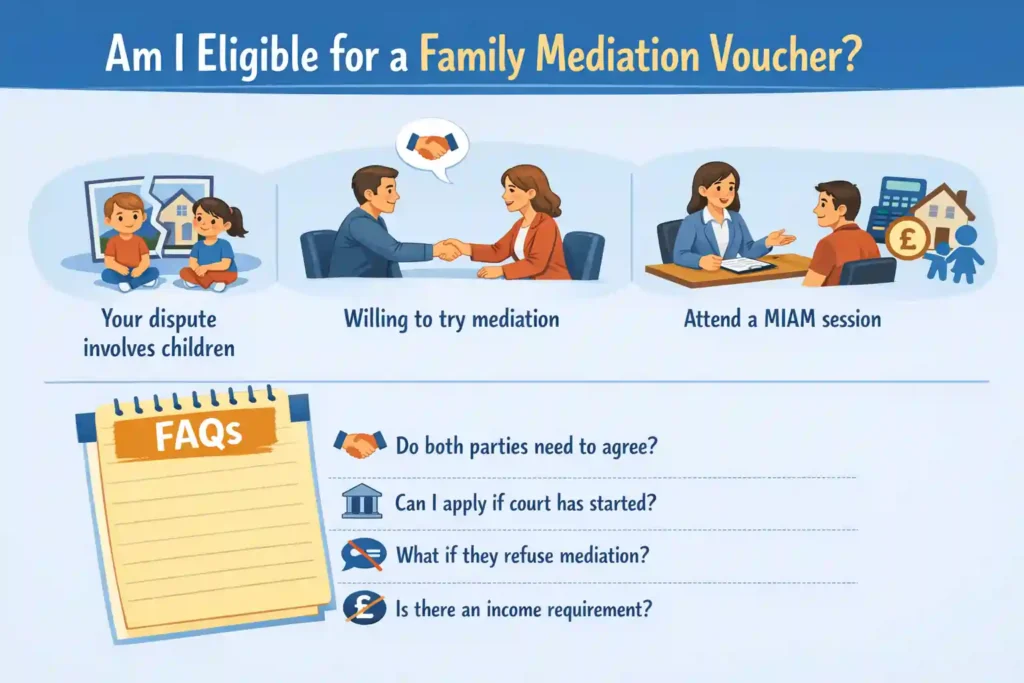
Am I Eligible for a Family Mediation Voucher?
Eligibility isn’t overly complicated, but there are a few key points to understand.
You may be eligible if:
- Your dispute involves children (this is the main priority)
- You’re willing to try mediation instead of going straight to court
- You attend a MIAM with an accredited mediator
In some cases, financial disputes may also qualify—but usually only if they are linked to child-related issues.
What Most People Ask at This Stage
Q: Do both parties need to agree to mediation?
Ideally, yes. Mediation works best when both sides are open to discussing and resolving issues.
Q: Can I still apply if court proceedings have started?
Yes, in many cases, you can still use mediation alongside court processes.
Q: What if the other person refuses mediation?
You can still attend a MIAM, but mediation itself may not proceed without both parties.
Q: Is there an income requirement?
No, this scheme is not means-tested like Legal Aid.
How Much Does the Family Mediation Voucher Scheme Cover?
The voucher scheme doesn’t cover everything, but it can still ease the cost quite a bit.
You can usually get up to £500 for child-related disputes and around £200 for financial-only cases (if eligible). The money goes directly to your mediator and is deducted from your total fees. See Our Mediation Cost Maidenhead here
So, while you may still have a small amount to pay, it makes mediation much more affordable and easier to move forward with.
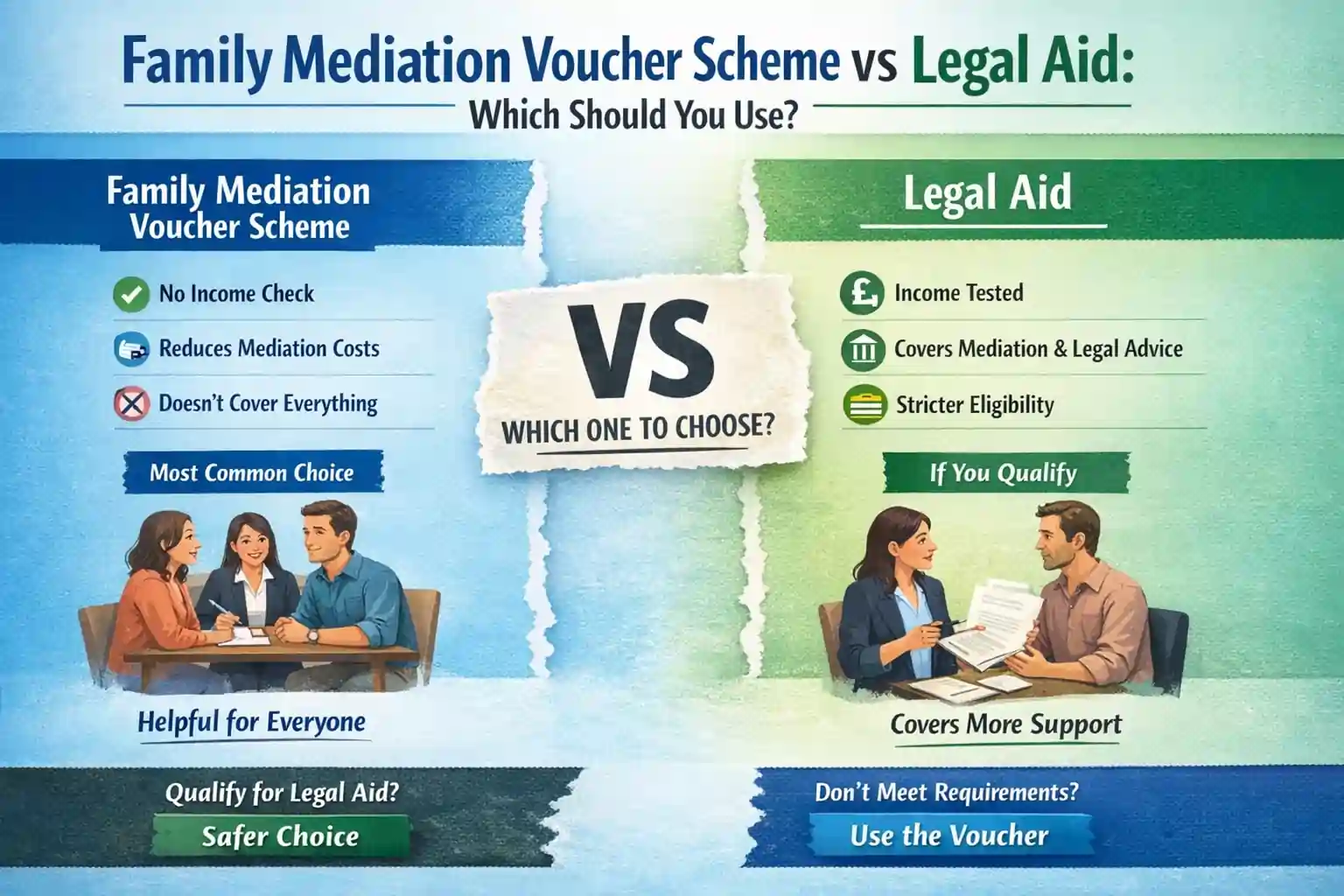
Family Mediation Voucher Scheme vs Legal Aid: Which Should You Use?
When people start looking into mediation, this question comes up pretty quickly—which one should I actually use?
Family Mediation Voucher Scheme Maidenhead
This is the one that everyone eventually uses. There’s no income check, so you needn’t wonder if you qualify financially. It doesn’t cover everything, but it removes some money from the price tag, which brings relief.
Legal Aid
Legal Aid can cover more, but it is not available to everyone. You will have to be under certain income and savings caps. If you do, it can cover mediation and even legal advice at times.
So, what does that mean in practice?
If you can qualify for Legal Aid, it’s the safer choice — primarily because it does so much more.
If you can’t, the voucher scheme remains a handy option. That won’t cover everything, but it doesn’t make you responsible for the entire cost alone.
5 Common Mistakes to Avoid When Applying for an FMVS Voucher
Even though the process is simple, there are a few common pitfalls:
- Skipping the MIAM: This is essential—you can’t access the voucher scheme without it.
- Assuming you apply directly: Your mediator handles the application, not you.
- Waiting too long: Funding is limited and can run out, so act sooner rather than later.
- Not checking eligibility early: A quick discussion with a mediator can save time.
Expecting full cost coverage: Remember, it’s a contribution—not a full payment.

Your Family Mediation Voucher: What Happens After You Get It?
Once your voucher scheme is approved, things move fairly quickly.
Your mediator will:
- Apply the voucher scheme amount to your sessions
- Schedule mediation meetings
- Guide discussions between both parties
From your side, your focus should be on open communication and working towards a fair agreement.
The aim isn’t to “win”—it’s to find a solution that works for everyone involved, especially children. See Here: What Is a Consent Order in the UK? A Simple Guide Every Couple Should Read
Can You Use a Family Mediation Voucher Scheme for Child Arrangements?
Yes, you can use it to do so — in fact, this is the most common way to use the scheme.
Child arrangements usually involve:
- Where children will live
- How many times will they see each parent
- Holidays and school schedules
This scheme is targeted at these cases because things are often less stressful when they are done by mediation than in court. It enables parents to agree on practical arrangements in a calmer, more flexible manner — focusing on the child’s wellbeing at the heart of every decision.
Family Mediation Voucher Scheme Maidenhead for Financial and Property Disputes
Obstacle to Housing — The plan centers primarily around children, but it can, at times, make things easier with issues relating to finances as well.
This might include:
- Division of savings or assets
- Property arrangements
- Financial responsibilities
Financial-only cases might have more constrained funding or limitations on whom they serve, however. It’s always a good idea to consult with a mediator early on.

Top Tips for Making the Most of Your Family Mediation Voucher
Getting the voucher is just the first step—how you approach mediation really matters. See Here: Family Mediation UK Explained: What It Is, How It Works & Who It’s For
Here are some practical tips:
- Be open and honest: Clear communication leads to better outcomes.
- Prepare in advance: Think about what you want to achieve before each session.
- Focus on solutions, not past conflicts: Mediation is about moving forward.
- Put children first: If children are involved, their wellbeing should guide decisions.
- Stay flexible: Compromise is key to reaching an agreement.
FAQS
Q: If I want to apply for the Family Mediation Voucher Scheme Maidenhead, but have no idea where or who to contact?
If you’re not certain where to start, that’s entirely understandable — most people feel this way in the beginning. Booking an MIAM with a mediator is the easiest step in this process. That first conversation generally clarifies things, and they will walk you through the voucher scheme process so you don’t have to navigate it on your own.
Q: If my ex-partner won’t participate in mediation, what happens — can I redeem or use the voucher?
If they are unwilling to participate, mediation can’t really work. And for that reason, the voucher will never be redeemed. Not perfect, but ideally, both individuals are on board with the process.
Q: Can I apply to the Family Mediation Voucher Scheme Maidenhead even if I have already submitted court forms, but want to explore settling things out of court?
Even if court proceedings have started, you can still attempt mediation. So many people take that route because they want to see whether they can work it out more peacefully, without going through the whole court process.
Q: What should I do if I’m worried that the voucher scheme won’t cover enough of the mediation costs and I can’t afford the rest?
That’s a very common concern. The voucher scheme helps, but it doesn’t cover everything. It’s a good idea to speak with your mediator early on about any remaining costs so you know exactly what to expect.
For Further Information, please Call Us On 03300 101 029