
If your family is heading into mediation and your child is old enough to have an opinion about what’s happening, you’ve probably wondered whether they should be part of the conversation.
Child-inclusive mediation, often shortened to CIM, is the process that lets them be without placing any decision on their shoulders.
There is a quietly powerful option that most parents don’t know exists. Once you do that, then the next question is whether it works for their family. Sometimes it is. Sometimes it isn’t. This, more than most guides will admit to, matters.
Read Here the Child Arrangements Guide To Understand What Your Rights Are.
What Child Inclusive Mediation Maidenhead Actually Is ?
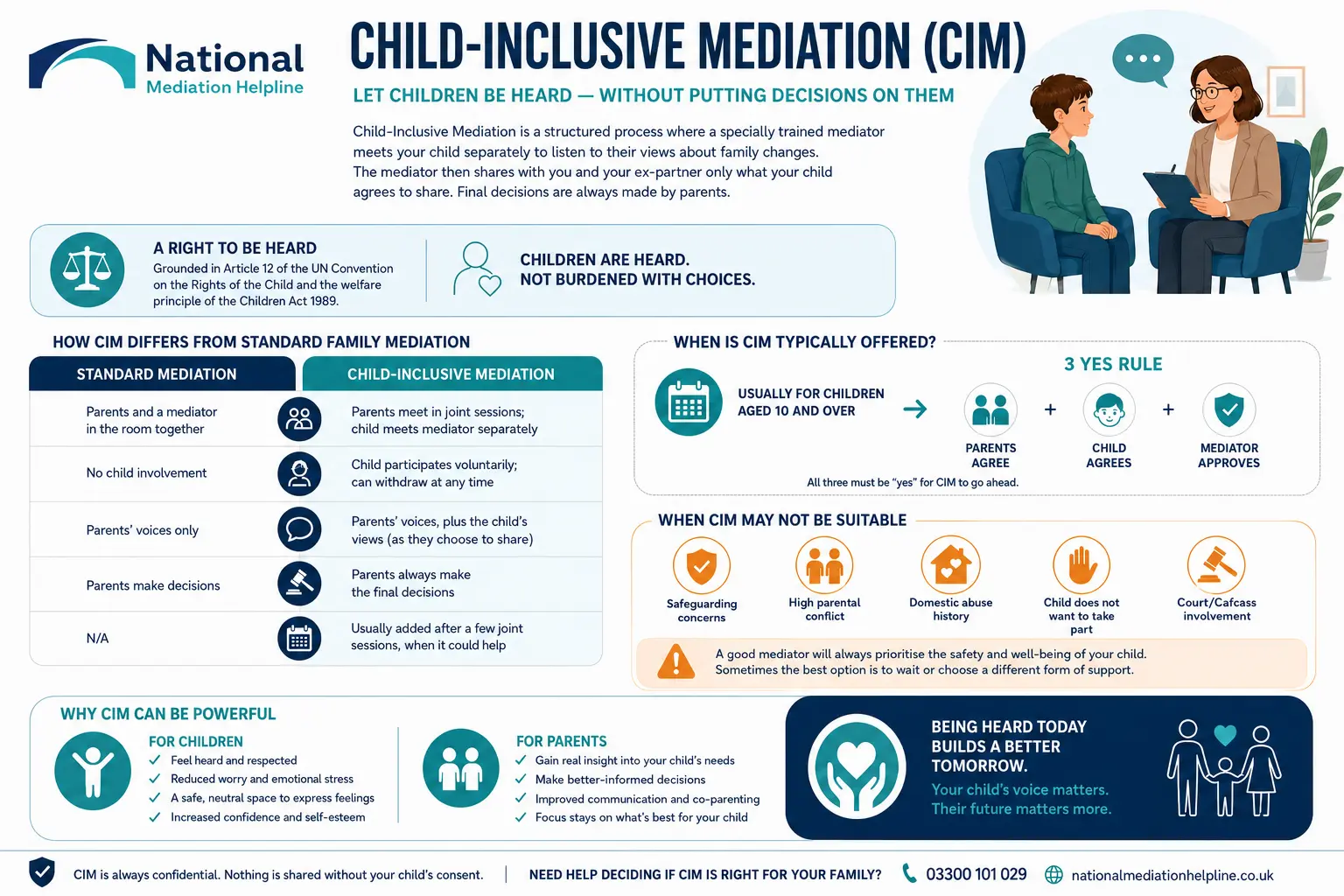
Child inclusive mediation is a structured part of family mediation where a specially trained mediator meets your child directly to listen to their views about what’s happening in the family. The mediator then feeds back to you and your ex-partner only what your child has agreed to share.
According to the Family Mediation Council, mediators are trained to help parents focus on making decisions that put their children at the centre, guiding them as they transition from being a couple to separated parents. Ultimately, parents are supported in making the final decisions in mediation regarding their children.
Your child isn’t deciding where they live or who they will be with for Christmas. They’re afforded the opportunity to share their side, on unbeknownst terms with an unbiased third party. They’re being given a chance to be heard, on their own terms, by someone neutral.
This isn’t a new or experimental approach in the UK. It’s grounded in Article 12 of the UN Convention on the Rights of the Child and reflected in the welfare principle of the Children Act 1989, both of which establish that children have a right to be heard in decisions that affect them.
How It Differs From Standard Family Mediation ?
Standard family mediation is a conversation between you and your ex-partner, with a mediator helping you reach an agreement. Your children aren’t in the room and aren’t usually involved at any stage.
Child inclusive mediation adds one specific thing: a separate, confidential meeting between your child and a mediator who’s qualified to work with children. The mediator then returns to your joint sessions with whatever your child has agreed they want shared.
Read the Full Detailed Guides on Family Mediation Maidenhead Here to Understand How it is different from Child Inclusive Mediation.
Here’s how the two compare in practice:
| Who’s in the room | Both parents and a mediator | Both parents in joint sessions; child meets mediator separately, alone |
| Mediator qualifications | FMC-accredited family mediator | FMC-accredited mediator with additional child consultancy training and enhanced DBS check |
| Child’s role | None | Voluntary participant; can withdraw at any point |
| Whose voice is heard | Parents only | Parents, plus the child’s views as they choose to share them |
| Who decides | Parents | Parents (always) |
| When it’s added | – | Usually, after a few joint sessions, once the parents and the mediator agree, it could help |
When Child Inclusive Mediation Maidenhead is usually offered
Across the UK, the guidance from professional bodies, including Resolution and the Family Mediation Council, is that children aged 10 and over should normally be offered the opportunity to take part. According to the Family Mediation Council, children can be included in mediation sessions if they are old enough and able to understand the process. Before any conversation takes place, certain requirements must also be met. Both parents must consent. The child must consent, in their own words, after the process is explained to them. And the mediator must be satisfied that CIM is genuinely going to help, not harm.
That third condition is where things get interesting, because most generic articles online skip it.
When Child Inclusive Mediation May Not Be Suitable ?

Most guides treat CIM as an across-the-board good thing. It often is. But there are situations where a properly trained mediator will decline to involve a child, and parents are usually relieved when someone explains why before they push for it.
Child Inclusive Mediation is generally not appropriate when:
- There are active safeguarding concerns about a child’s well-being.
- One parent is showing signs of alienating behaviour, where bringing the child in could make things worse.
- Conflict between parents is so high that the child would feel pressured by either side after the session.
- A child has expressed they don’t want to take part (their refusal is final, not a starting point for persuasion)
- There’s a history of domestic abuse, and the child has been exposed to it.
- A live court process is dealing with the same questions, and Cafcass is already involved.
If any of those apply, the mediator may suggest something else: pastoral support through school, family therapy, an independent counsellor, or simply waiting until things settle. Saying “not now” or “not at all” is a sign of a good, inclusive mediator, not a closed door.
What Does Your Child Actually Experience In The Room?
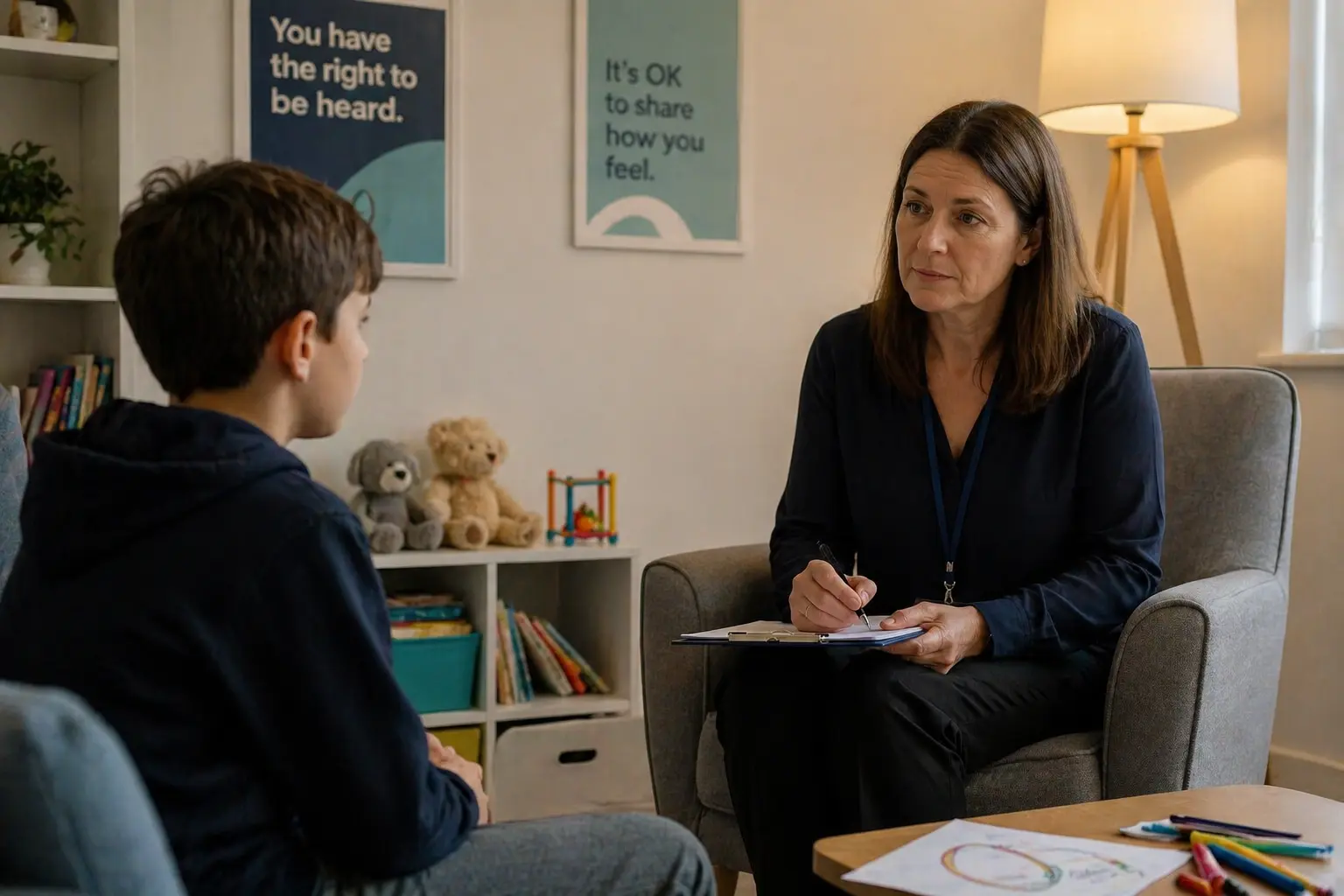
Here’s the part most guides leave vague. If your 11-year-old is about to meet a mediator, you probably want to know what’s going to happen to them for that hour, not just the policy framework around it.
The session is held somewhere neutral. That’s usually the mediator’s office, sometimes a friend’s home, occasionally school. Not your house, and not your ex’s.
Many children have different preferences for how they take part in mediation, with some feeling more comfortable meeting in person and others preferring video sessions.
According to the Family Mediation Council, mediators will introduce themselves at the start and explain their role, including informing children aged 10 and over about their right to be consulted as part of the mediation process.
Yet they will explain that anything the child says will not be relayed to either parent (unless the child gives permission). That is an evergreen promise, come what may.
Brief conversations begin with the stuff that makes up a child’s interests, abilities and social circles. Not the divorce. The mediator could use diagrams, scaling questions (how are things going at the moment, out of 1-10), prompts on what a typical week looks like at your school, or similar prompts. For younger children, use puppets or pictures.
At the end, the mediator will ask what the child would want their parents to know, if anything. A child selects, word by word. And then there’s a feedback session with the parents where we only share what the child is comfortable telling.

How the National Mediation Helpline Maidenhead can help
If you’re considering child inclusive mediation, the most useful first step is a short call to talk through whether it fits your situation. Not every family needs it, nor is every case suitable for it. We can help you understand whether CIM is likely to be offered, what to look for in a child consultant mediator, and how to prepare your child for the conversation.
You can book a free consultation with National Mediation Helpline. The call is free, the advice is honest, and you’re under no obligation to proceed afterwards.
It Works When It’s Works Really Well : The Issues And Opportunities
The best evidence comes from how kids themselves describe it. According to the Family Mediation Council, child-inclusive mediation gives children the chance to express their views and feelings in a neutral and safe setting during family disputes.
Such as when parents are separating or divorcing. The Council shares feedback from children who participated, noting that CIM allows their voices to be genuinely heard, which many find supportive.
For parents, the benefit is more practical. You walk into the next session with information you didn’t have before, not opinions filtered through your ex-partner, but your child’s own perspective relayed by someone they trusted enough to share it with.
According to research by Bell and colleagues, while both mainstream and child-inclusive mediation led to positive experiences for participants, child-inclusive mediation was not shown to be more effective at improving parental relationships or resolving disputes.
A 2013 study from Felicity Bell and colleagues found that, while both child-inclusive and traditional mediation approaches offered positive outcomes, involving children directly in mediation did not lead to greater improvements in parental relationships or the likelihood of resolving disputes. It doesn’t have to mean being put in charge.
What To Think About Before You Raise It ?
If you’ve read this far and you’re wondering whether to ask your mediator about Child Inclusive Mediation Maidenhead at your next session, here’s the most useful thing to hold in mind. The decision isn’t really yours alone, and that’s the point. Your ex-partner has to agree, your child has to want to take part, and the mediator has to feel it’ll help. Three “yes” answers, freely given, are what make it work.
If you’d like to explore whether your family meets that bar, get in touch with National Mediation Helpline for a quiet, no-pressure conversation about what your options actually are.
We Care. We Listen. We Respect. We are Practical. We are There for You.
Frequently asked questions : Child Inclusive Mediation Maidenhead UK

At what age can a child speak to a mediator in the UK?
The working guidance is that children aged 10 and above should normally be offered the chance to take part in child inclusive mediation. Younger children can sometimes participate, particularly where they have an older sibling already involved or where the mediator and parents agree the child is articulate enough to benefit. There’s no fixed lower limit, but participation is always voluntary.
Does my child have to choose between us?
No, and any properly trained child inclusive mediator will make this explicit to your child at the start. The session is not about asking your child where they want to live or which parent they prefer. It’s about understanding how they’re feeling and what they’d like the adults to know. Decisions stay with the parents.
Will what my child says be used against me?
No. Child inclusive mediation is confidential, and the mediator only shares what your child has specifically agreed to share. Nothing said in a CIM session can be used as evidence in court, in the same way that all family mediation discussions are without prejudice. The child’s voice is for the parents to hear, not for the legal system to act on.
Is child inclusive mediation free in the UK?
It depends on the provider. Some organisations, including National Family Mediation, offer CIM sessions free of charge as part of their service. Others charge a separate fee, usually shared between parents. The Family Mediation Voucher Scheme, run by the Ministry of Justice, can also contribute up to £500 toward family mediation costs where children are involved, which can be applied to CIM in many cases.