
Nobody prepares you for the MIAM. Your solicitor mentions it, or you spot it on a court form, and you file it somewhere between sorting that later and trying not to think about it. Then suddenly it’s real, and you’re Googling it at midnight, wondering whether you’re about to be stuck in a room with your ex while a stranger decides something about your kids.
You’re not.
An MIAM is a private, one-to-one meeting with a trained mediator. Your ex has their own separate appointment. Nothing about your children gets decided at this stage. The mediator isn’t a judge, and they’re not there to rule on anything. What they are there to do is explain your options properly and assess whether mediation could work for your situation before the court process takes over.
What Is a MIAM and Why Does It Apply to Child Arrangements?

A MIAM is at the gateway between family breakdown and court. It is true that you can’t apply for a child arrangements order, about where your child will live (and with whom) and how decisions are made day to day, without showing that mediation, as an alternative way of resolving the dispute other than the court route, has at least crossed your mind. Find a Mediator Near You Maidenhead
A part of the Children and Families Act 2014 provides for this tutelage, and the courts take it very seriously. In April 2024, family court judges were even granted powers to adjourn proceedings in cases where an MIAM hasn’t been attended: so basically, if you or your party don’t attend one, your case can be paused, and you’ll now need to complete a MIAM before anything happens.
And none of this is to force anyone into mediation.” It’s to make sure every parent has a full hand going in with an accurate picture of the options available, and that they engage in what, for most parents, is a more rapid-moving process than they understood it would be going in and one that may be more expensive and juicing to co-parenting relationships than most people know.
A MIAM is not an agreement to mediate. That means going to an information meeting. That distinction matters.
What Actually Happens During Your MIAM for Child Arrangements?

If you’ve been told you need an MIAM before going to court over your children, there’s a good chance you think it means sitting across the table from your ex. It doesn’t.
An MIAM(Mediation Information and Assessment Meeting) Maidenhead is a private, one-to-one meeting between you and a qualified mediator. Your ex isn’t in the room. Nothing is negotiated at this stage. And for most parents applying for a child arrangements order in England and Wales, attending one is a legal requirement before a court will accept your C100 application. That’s the bit most people searching “MIAM child arrangements UK” haven’t been told clearly.
This guide to “MIAM Child Arrangements UK” explains what actually happens at the meeting, what the mediator is looking for, what it costs, and your choices at the end.

💡 WHAT MOST GUIDES WON’T TELL YOU
For MIAM Child Arrangements UK Maidenhead , A MIAM for child arrangements isn’t a generic suitability check; it includes a specific domestic abuse and safeguarding screen. The mediator is assessing whether mediation would be safe and appropriate for your particular circumstances, not just whether you’re willing to try it. If safeguarding concerns exist, the mediator will not recommend proceeding to joint sessions.
The meeting typically lasts 45 minutes to an hour. It’s fully confidential; nothing you say can be used as evidence in any court proceedings.
The mediator will begin by asking you to describe your situation: what the dispute involves, the arrangements currently in place for the children, and the main issues between you and your ex. For child arrangements specifically, that usually means questions about where the children are living, how contact is working (or not), the children’s ages, and what you’re hoping to resolve.
From there, the mediator explains the mediation process in the context of your situation, how sessions work, how many are typically needed for child arrangements disputes, and how any agreement reached can be formalised. They’ll also outline the alternatives, including collaborative law, solicitor-led negotiation, arbitration, and the court route itself. Read Here : what can be agreed in MIAM Child arrangements UK and What Can’t, A Recommended guide,
But here’s one important thing that almost no article has been quite so clear about: a MIAM for child arrangements includes a domestic abuse and safeguarding screen. There are specific questions that the mediator is trained to ask about safety, your safety, and your children’s, as a separate part of the assessment.
This is not just a formality. It’s a substantive check. It operates separately from the overall suitability assessment. And can directly influence whether mediation is advised and, if so, how. If a mediator discovers safeguarding issues, they won’t force you into joint sessions.
If your children are over 10, the mediator will also raise the option of child-inclusive mediation, a separate process where the children have a confidential conversation with a specialist, so their views can genuinely inform the outcome
Will You Have to Sit in the Same Room as Your Ex?

No, and this is the most common fear about the process, and it’s unfounded. In many cases of MIAM Child Arrangements UK Maidenhead.
Each party attends their own separate MIAM. You meet the mediator alone. Your ex has a separate appointment, at a different time or even a different day. You won’t be in the same room at any point during the MIAM stage.
And it goes further than MIAM child arrangements UK. Your MIAM can go ahead even if your ex hasn’t booked theirs. You attend, get your certificate, and proceed with your court application. If your ex refuses to engage with the MIAM process at all, the mediator notes that on the certificate, and courts increasingly take a dim view of a party who declines without a legitimate reason. It won’t automatically decide the case against them. But a judge will notice, and it’s a question they may have to answer at the first hearing.
Now, online MIAMs are available and accepted by Courts across England and Wales. If you have concerns about proximity, mobility or safety, ask the provider if a remote appointment is possible.

🤝 HOW NATIONAL MEDIATION HELPLINE CAN HELP Maidenhead
If you’ve reached the point where a MIAM is your next step before applying for a child arrangements order, you’re not alone, and you’re in the right place. National Mediation Helpline can connect you with an FMC-accredited mediator and check your legal aid eligibility before you commit to anything.
Not sure if mediation is right for your situation? That’s exactly what the MIAM is designed to help you figure out, gently, without pressure, and at your own pace.
What Is the Cost of MIAM Child Arrangements in the UK?
The straight answer is that costs vary a lot more than most providers’ websites admit. Here’s a clear breakdown:
| Standard MIAM (per person) | A Lot lesser than courts |
| Legal aid eligible | Free — including ex-partner’s costs if they qualify through you. |
| MIAM certificate (sometimes charged separately) | £50–£80 ( In case of Charged Separately) |
| Family Mediation Voucher Scheme | £500 off subsequent mediation sessions (not the MIAM itself) |
| Online MIAM | Comparable cost to in-person. Book a Consultation with us to know more on this. |
A few things matter here that the headline figure doesn’t tell you.
In MIAM child arrangements UK, some providers include the MIAM certificate in their fees. Others charge it separately. You need that signed certificate to attach to your C100; without it, the court won’t process your application, so always ask before you book whether it’s included.
If you’re eligible for legal aid, your MIAM costs nothing. A provider registered to deliver legal aid work will check your eligibility before the meeting. If your ex doesn’t qualify for legal aid independently but meets certain financial criteria, their MIAM may be covered through your eligibility, too.
Read Here the Detailed Guide on Child Arrangements in UK
The government’s Family Mediation Voucher Scheme offers up to £500 per family towards mediation sessions; this applies to sessions following the MIAM, not the MIAM itself. But if your MIAM leads to full mediation for your child arrangements, it’s worth knowing about from the start. To make the sessions worth it in MIAM child arrangements UK.
One more thing that catches people out: your MIAM certificate is valid for only 4 months. If you don’t file your C100 within that window, you’ll need to attend a new MIAM before the court will accept your application.
What Does the Mediator Decide at the End?

Three outcomes are possible in the MIAM child arrangements UK. The mediator may conclude that mediation is suitable, in which case they’ll invite both parties to book an initial joint session. They may determine that mediation isn’t suitable in your circumstances, most often where there are domestic abuse concerns, a significant power imbalance, or where one party has made clear they won’t engage. Or you yourself may decide, having heard the information, that you don’t want to proceed with mediation, and that is entirely your right.
Whatever the outcome, the mediator signs and issues your MIAM certificate. You attach this to your C100 application. The mediator cannot force you into mediation. They cannot make any decisions about your children. And they don’t report the content of your discussion to the court, only that you attended, and what the outcome was. This is the whole outcome of the MIAM child arrangements UK.
When Can You Skip the MIAM Child Arrangements UK?
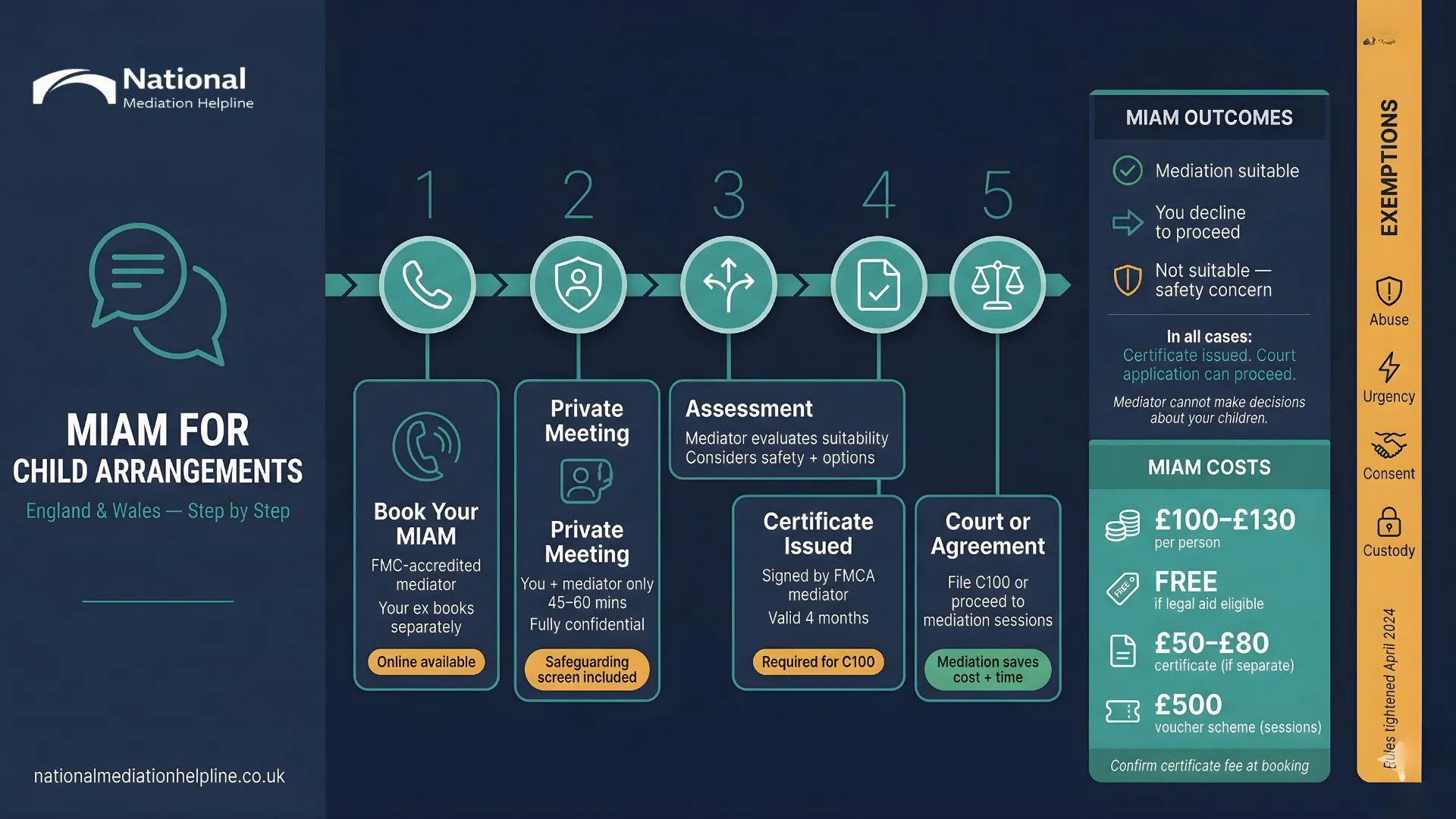
In a few instances of MIAM child arrangements UK, the court will receive a C100 without an MIAM certificate. These are MIAM exemptions, and the rules around these have been tightened considerably since April 2024.
The most commonly relied-on exemptions for child arrangements cases include being a victim of domestic abuse as evidenced by, for instance, a police report or criminal conviction; urgency where there is an immediate risk to the child; agreement already reached between the parties with no issues (‘consent’ order); and impracticability.
What’s different after 2024 is the level of scrutiny. Judges may now place the proceedings on hold and order an MIAM to occur beforehand. A party that has asserted an undue burden that it cannot prove on the first go is in a different situation.”
If you think an exemption could apply to you, check with a qualified family law adviser before marking any boxes on the C100. Mistakes here don’t just slow things down; they can influence a judge’s impressions of whether you are putting the children first.
A MIAM is not some administrative burden. It’s an hour-long private meeting that, for many parents, shows a speedier, much less destructive path than court. Even parents who were absolutely adamant they would require a judge to decide things have left a MIAM with an implementable plan never contemplated by them. If you’re at this point, the most manipulative next step is to find a mediator accredited by the Family Mediation Council, see if you qualify for free mediation, and book that first appointment. The National Mediation Helpline can do all of that with a single call. Solving your hurdles in MIAM child arrangements UK.
Questions You May have on MIAM Child Arrangements UK

Does my ex have to go to the MIAM Maidenhead as well?
Your ex goes to their own MIAM, you never meet. Whether or not your ex has booked, your meeting can go on. If your ex will not participate in the process at all, then they will note that on your MIAM certificate, and the court could draw its own conclusions.
How long does a MIAM actually last?
Most MIAMs take 45 minutes to one hour. It’s a one-to-one meeting with the mediator; it’s partly just showing up; there’s no prep beyond being ready. to tell your story and the main problems you want fixed. If you are straightforward to assess, the session will be shorter, and the solution will be faster.
Am I eligible for legal aid for an MIAM Maidenhead?
Yes, where you qualify for legal aid, your MIAM is free. A mediator will verify your eligibility if you are registered to provide legal aid work. The point of booking. In some cases, your ex-partner may also have their MIAM validated and included through your eligibility, even if they wouldn’t be eligible independently. Check the Full Scheme Details.
How long is the validity period of the MIAM certificate?
A MIAM certificate lasts for four months from when it is issued. If you haven’t submitted your C100 within that timeframe, you will have to go to a new MIAM to a court that will accept your application. If you consider that some of those circumstances may have changed significantly. A new MIAM is also likely to be appropriate regardless of timing.
Does the NMH Maidenhead provide an estimate of the mediation cost?
Yes, the National Mediation Helpline Maidenhead offers a clear-cut cost structure. You can read the in-depth guide on mediation costs. Or you can book a consultation with us to get a finalised cost breakdown in the easiest way possible.
Do I need to attend a MIAM if my ex has been abusive?
In most domestic abuse cases, a MIAM exemption applies, meaning you may not need to attend before issuing your C100 application. You’ll generally want supporting evidence, like a police report, a rigorous investigation, or a letter from an established domestic abuse group. Courts have applied more scrutiny to these since April 2024. exemptions, so do take advice from a family law solicitor before choosing which route to take.
What happens if my ex says no to mediation after the MIAM?
In the event that either party does not wish to proceed to mediation after the MIAM, the mediator will confirm this on the signed certificate, and you may use it to submit your C100. You don’t need your ex’s permission for the MIAM process. A judge might inquire as to why mediation was not attempted, so it helps to have a clear, honest answer prepared.
Is everything I say during a MIAM confidential?
Yes. All that is said in a MIAM is confidential and cannot be used as evidence in court proceedings. The mediator reports only to the court. that you went to, and what the result was, not your actual conversation. This aspect of confidentiality is part of what makes the MIAM a meeting of real use, not just a box-ticking exercise.
Is it possible for me to have my MIAM online?
Online MIAMs are now offered by many providers and widely accepted by courts in England and Wales. Many providers are setting video appointments, which can be especially helpful if distance, disability or safety concerns prevent In-person attendance. Confirm with your selected provider, as scheduled in the booking, that they are qualified to schedule and certify MIAMs online. This is normal in newer MIAM child arrangements UK cases or other family mediations cases.
Your Best Move forward, and a Sigh of Relief
Here’s the truth nobody says out loud: reaching this stage, searching for information about MIAMs, reading court forms, and figuring out next steps is exhausting. You’re doing all of this while also being a parent, probably while also not sleeping particularly well.
You don’t need another website telling you what MIAM stands for. You need someone who can look at your specific situation, your children, your circumstances, your ex, and tell you honestly what your best move is.
That’s what National Mediation Helpline does.
We are not a law firm. We are not going to charge you for a question. We work with FMC-accredited mediators across England and Wales. They’ll check your legal aid eligibility before anything else, and if mediation genuinely isn’t right for your situation, we’ll tell you that too.
The next step is simple. Call NMH or arrange a free consultation for MIAM child arrangements UK, and let someone who handles this every day take some of the weight off your shoulders.