
If you’re dealing with a separation, trying to sort out arrangements for your children, or working through financial issues, chances are you’ve got a lot of questions. Family mediation is often suggested as a calmer, more cost-effective alternative to going to court—but what is it actually like in real life?
This guide answers the most common family mediation FAQs in the UK Maidenhead, based on real concerns people have when they’re unsure what to do next.
Is Family Mediation Mandatory Before Court in the UK?
In most cases, yes—you are expected to consider mediation before going to court.
Before applying to a family court, you usually need to attend a MIAM (Mediation Information and Assessment Meeting). This is a short session where a mediator explains your options and checks whether mediation is suitable for your situation. See Here: What Is Legal Aid Mediation in the UK?
However, mediation is not always required. You may be exempt if:
- There is domestic abuse involved.
- The case is urgent
- The other person refuses to attend
- You’ve already tried mediation recently.
So while mediation isn’t strictly “mandatory,” attending a MIAM is often a required step.
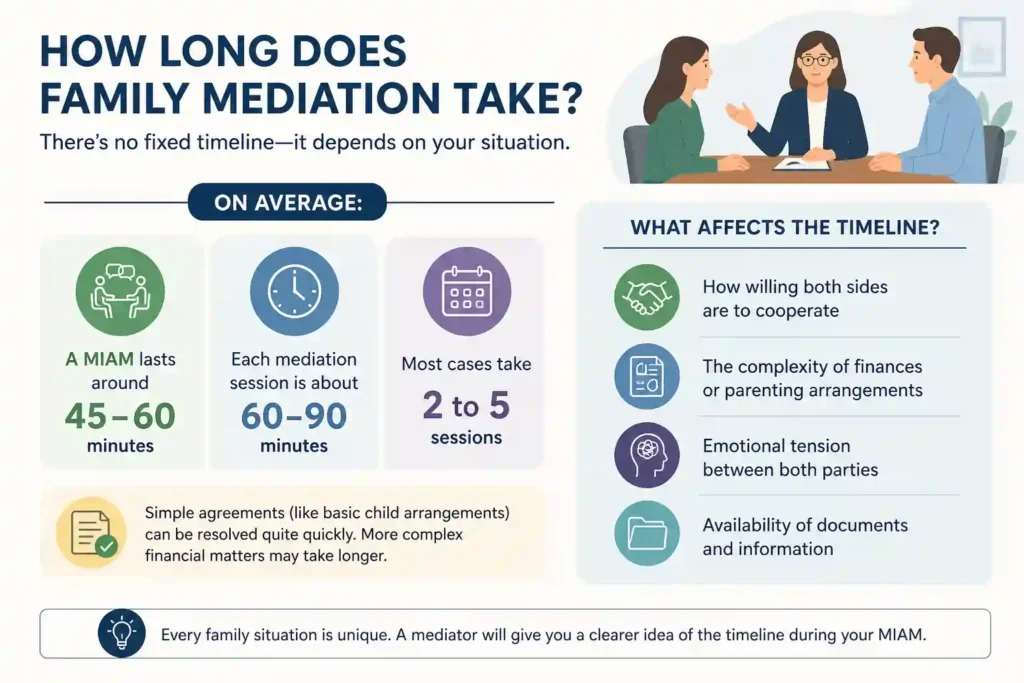
How Long Does Family Mediation Take?
There’s no fixed timeline—it depends on your situation.
On average:
- A MIAM lasts around 45–60 minutes
- Each mediation session is about 60–90 minutes
- Most cases take 2 to 5 sessions
Simple agreements (like basic child arrangements) can be resolved quite quickly. More complex financial matters may take longer. What Is Property Division Mediation? A UK Guide
What affects the timeline?
- How willing both sides are to cooperate
- The complexity of finances or parenting arrangements
- Emotional tension between both parties
- Availability of documents and information
Will Mediation Work If We Don’t Get Along?
This is one of the biggest concerns—and the honest answer is: yes, it still can.
Mediation Maidenhead is designed for people who don’t see eye to eye. You don’t need to be on good terms to make it work. Child Inclusive Mediation UK: Should Your Child Have a Voice?
A trained mediator:
- Keeps things from going off track and helps the conversation stay balanced
- Makes sure you both get the chance to speak and be listened to
- Steps in when things get tense, so it doesn’t turn into another argument
Even in high-conflict situations, mediation can still work because it shifts the focus to sorting things out practically, rather than going back over what’s already happened.

Is What I Say in Mediation Confidential?
Yes—mediation is generally confidential.
This means:
- What you discuss cannot be used in court
- Conversations stay private between you, the other party, and the mediator
However, there are a few exceptions:
- If there are concerns about child safety or harm
- If illegal activity is disclosed
- Financial statements may be shared if formalised into agreements
This confidentiality allows people to speak more openly and honestly.
How Much Does Family Mediation Cost in the UK?
Costs can vary depending on the provider and the complexity of your case. See Here: How Much Does Mediation Cost in the UK Maidenhead? A Complete Guide
Typical costs:
- MIAM: around £80–£150 per person
- Family Mediation sessions: £100–£250 per person, per session
Some key things to know:
- Costs are usually shared between both parties
- Legal Aid may cover some or all costs if you qualify
- Family Mediation is usually far cheaper than going to court
Overall, family mediation is seen as one of the most cost-effective ways to resolve disputes.

What If My Ex Doesn’t Want to Mediate?
More common than you may think, this happens.
If your ex refuses:
- The mediator will ask them to go alongside an MIAM
- If they refuse again, you can take them to court.
Mediator provided me with documentation confirming:
- Family Mediation was attempted
- Non-engagement with the other party
This enables you to proceed legally when required. What Is Shuttle Mediation Maidenhead? A Simple UK Guide
Can Children Be Involved in Mediation?
Yes—but only when appropriate.
This is known as child-inclusive mediation, and it’s handled carefully.
It may be suitable when:
- Children are old enough to express their views
- Both parents agree
- A trained specialist is involved
Children are not asked to make decisions. Instead, they are given a safe space to share how they feel, which can help parents make better choices.

Can Mediation Cover Finances and Child Arrangements Together?
Yes—this is one of mediation’s biggest advantages.
You can deal with:
- Child arrangements (where children live, contact schedules)
- Financial matters (property, savings, maintenance)
Handling everything in one process:
- Saves time
- Reduces stress
- Creates more balanced agreements
It also helps ensure decisions about children and finances work together realistically.
What Happens After Mediation?
Once you reach an agreement, the mediator prepares documents such as:
- Memorandum of Understanding – outlines what you’ve agreed
- Open Financial Statement – summary of financial details
To make it legally binding:
- A solicitor can turn the agreement into a Consent Order.
- This can then be approved by the court
If no agreement is reached:
- You can still go to court
- But you’ll have shown you made an effort to resolve things first
FAQs: Real Problems People Face in Family Mediation (UK)
Q: We can’t have a simple conversation without arguing—how is mediation supposed to work for us?
That’s exactly what mediation is designed for. A trained mediator manages the conversation so it doesn’t turn into an argument. You can also be kept separate if needed, making the process much less stressful.
Q: My ex refuses to attend mediation—does that mean I’m stuck or have no other option?
No, you’re not stuck. If they refuse, you can still go to court. The mediator will provide proof that mediation was attempted, which allows you to move forward legally.
Q: I’m worried about costs—what if mediation ends up being just as expensive as going to court?
Family mediation Maidenhead is usually much cheaper than court. Costs are shared, and you only pay per session. Legal Aid may also be available to reduce or cover fees.
Q: We have both financial issues and child arrangements to sort out—do we need separate processes for each?
No, mediation can cover both at the same time. This makes things simpler and helps create more practical, joined-up agreements.
Q: I don’t feel comfortable speaking openly—what if what I say is used against me later in court?
Family mediation Maidenhead is confidential, so what you say usually can’t be used in court. This helps you speak more openly without fear.
Q: What if we go through mediation and still can’t agree on anything—have we just wasted time?
Not at all. It can still clarify issues and show the court you tried to resolve things. That can help your case moving forward.
For Further Information, please Call Us On 03300 101 029