
Most parents who hesitate about child-inclusive mediation aren’t being selfish. They’re scared. Scared that their child will say something painful. Scared the other parent will weaponise it. Scared they’ll lose control of a situation that already feels completely out of hand.
Here is the reality: those fears are based on a version of the process that simply doesn’t exist.
Child Inclusive Mediation UK is designed around protecting the child. Not extracting statements. Not producing evidence. Your child doesn’t choose which parent to live with. They don’t sit in on adult discussions. And they decide, right at the end of their session, exactly what the mediator is allowed to pass back to you. Not the mediator. Not your ex. Your child. That distinction matters more than most articles explain.
Here’s what child inclusive mediation UK actually involves, how the process works in practice, and what your options are when things get complicated.
What Child Inclusive Mediation UK Actually Is ? (and What It Isn’t?)

Child Inclusive Mediation UK is a structured process where a specially trained mediator spends private, confidential time with your child during a family mediation. The child gets a space to talk about how they’re feeling and what matters to them as the family adjusts to life after separation. This is also known as CIM.
That’s the whole thing. The child is not a witness. They are not decision-makers.
Think about it this way: every adult in a mediation gets their own private session with the mediator. Child Inclusive Mediation UK, gives children the same thing. Their own space, their own voice, without a parent nearby.
What actually surprises parents is how different this is from what they imagined. There’s no table. No formal questioning. No notebook is being filled in.
Depending on the child’s age and personality, the session might involve drawing, storytelling, or relaxed conversation. This is applicable for whole “Child Inclusive Mediation UK” process.
You can find even more helpful insights here on child access mediation
The mediator’s job is to understand the child’s emotional sphere, not to build a case. The questions are open. The pressure is nil.
And the feedback? The child controls it entirely. At the end of the session, the mediator asks the child directly, “What would you like me to tell your parents?” What do you want to stay private?
Nothing moves forward without the child’s permission. That’s not a formality or a reassuring policy statement. It’s how the process is built.
💡 What Most Articles Won’t Tell You
Under the Family Mediation Council’s Code of Practice, every FMC-accredited mediator is required to offer child-inclusive mediation to any family where at least one child is aged 10 or over. The offer is mandatory. Taking it up is not. If your mediator hasn’t raised it and you have a child aged 10 or above, you can ask. Which is the most critical part of whole Child Inclusive Mediation UK Maidenhead.
When Child Inclusive Mediation Maidenhead Makes Sense in the UK
Child Inclusive Mediation UK works best when both parents are genuinely open to hearing what their child has to say. Even if it’s uncomfortable. It tends to fit situations where:
- Parents have been going around the same disagreements without landing on a solution.
- A child has clearly been affected and hasn’t had a proper outlet for their feelings.
- The signals about what the child actually wants are conflicting or hard to read.
- Decisions under discussion will significantly shape the child’s daily life.
But Child Inclusive Mediation isn’t right for every family. A trained mediator will assess suitability before it’s formally offered. It’s typically not recommended where safeguarding concerns are present, where abuse allegations have been made, or where a child is already working with a counsellor or social worker. In those situations, the mediator may need to speak with the existing professional first before arranging anything. This is to ensure the process doesn’t undermine any therapeutic support the child already has.
How Child Inclusive Mediation UK Maidenhead Works: The Process Step by Step
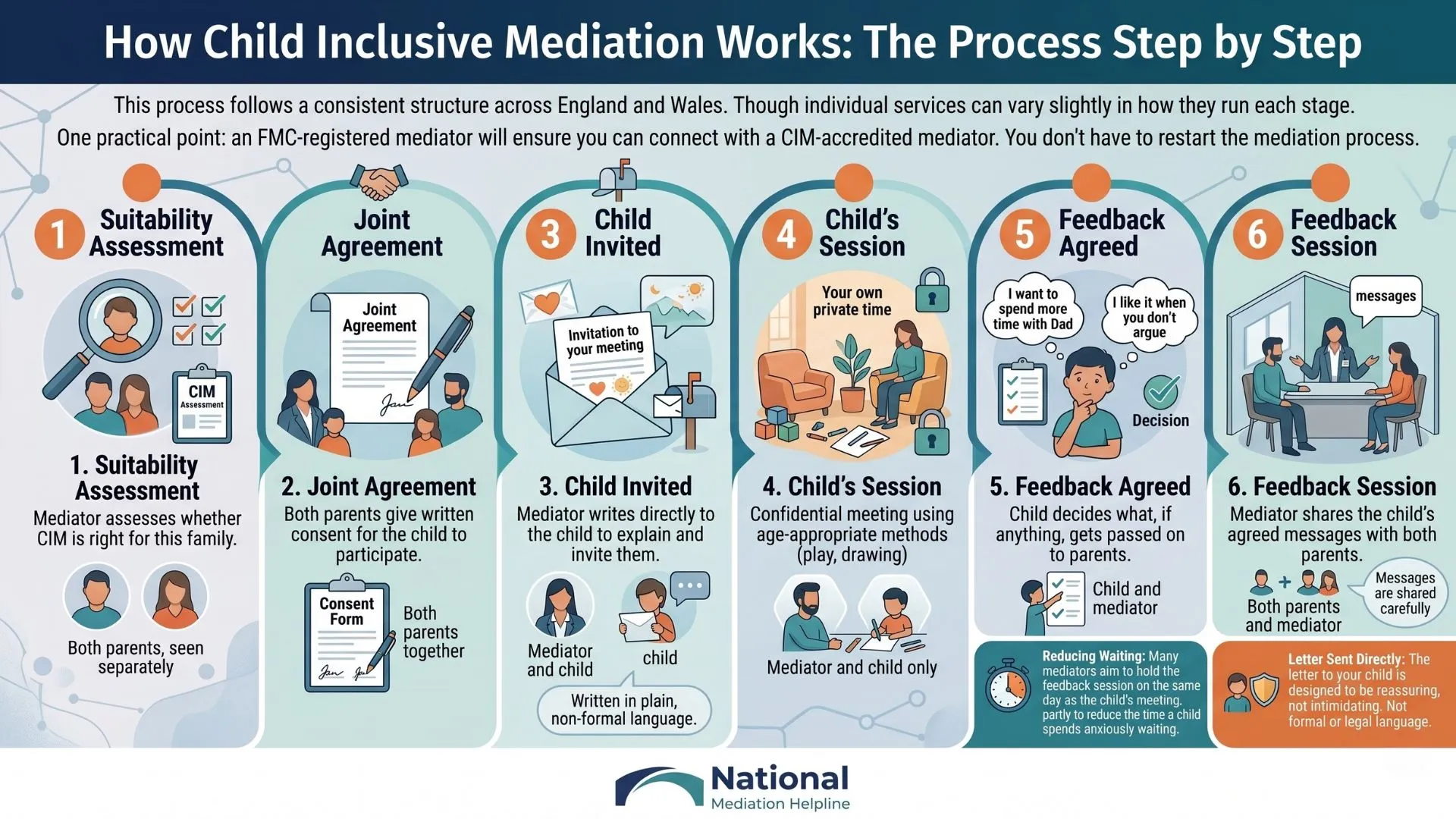
This process follows a consistent structure across England and Wales. Though individual services can vary slightly in how they run each stage:
| 1. Suitability Assessment | Mediator assesses whether CIM is right for this family | Both parents, seen separately |
| 2. Joint Agreement | Both parents give written consent for the child to participate | Both parents together |
| 3. Child Invited | Mediator writes directly to the child to explain and invite them | Mediator and child |
| 4. Child’s Session | Confidential meeting using age-appropriate methods | Mediator and child only |
| 5. Feedback Agreed | Child decides what, if anything, gets passed on | Child and mediator |
| 6. Feedback Session | Mediator shares the child’s agreed messages with both parents | Both parents and mediator |
A few things worth noting about how this works in practice. The letter sent to your child is written directly to them, not in formal or legal language. It’s designed to be reassuring, not intimidating. Many mediators aim to hold the feedback session on the same day as the child’s meeting, where possible, partly to reduce the time a child spends anxiously waiting to see how their parents respond.
One practical point that often gets overlooked: not every mediator holds CIM-specific accreditation. But an FMC-registered mediator who isn’t trained for Child Inclusive Mediation UK is expected to be able to connect your family with one who is. You don’t have to restart the mediation process.

How National Mediation Helpline Maidenhead Can Help
If you’re already in mediation and the question of your child’s involvement has come up, NMH can help you work out whether CIM is the right fit for your specific situation. Sometimes a short conversation with an experienced mediator is all it takes to go from uncertain to clear. Book a free consultation with NMH and talk it through before you make any decision either way.
What Age Does a Child Need to Be for Child Inclusive Mediation UK in Maidenhead?

The Family Mediation Council’s Code of Practice sets 10 as the age at which children should be offered CIM. Ten is the threshold. Not a hard floor.
Younger children can be seen in appropriate circumstances. It comes down to the individual child. A thoughtful, expressive nine-year-old might engage meaningfully. A ten-year-old who isn’t ready might not. The mediator assesses this case on a case-by-case basis, always with the child’s well-being as the only thing that matters.
There is no upper age limit. A 16-year-old still living at home and directly affected by parental decisions is just as legitimate a candidate as a younger child. Read more on Child Access Mediation.
A teenager has a completely different relationship to these decisions than a seven-year-old does. Where they go to school, which parent is ten minutes from their best friend, and what their week actually looks like when two households are involved. Those details belong to the teenager in a way they don’t yet belong to a younger child, and a good mediator understands that.
The invitation is written to the child personally, and what they do with it is entirely their call. A parent can’t accept it on their behalf. If the child puts the letter down and says nothing, or says no, that’s a complete answer, and nobody treats it as a problem to be solved. What tends to happen in practice is that most children don’t say no, though perhaps not for the reason parents assume.
It isn’t that children are naturally cooperative or that they feel obliged. It’s closer to this: after weeks or months of measuring every word at home, knowing that whatever they say will land somewhere complicated, being asked a straight question by someone who has absolutely no preference about the outcome can feel like the first genuinely easy conversation they’ve had in a long time.
What Actually Happens in a Child Inclusive Mediation UK Maidenhead Session ?

Parents tend to picture their child sitting across from a stranger, being asked pointed questions while notes are taken. That’s not it.
The mediator’s job is to make the child feel genuinely safe and genuinely heard. With younger children, the session might use drawing or a more playful kind of conversation. With older children, it tends to be more direct. But in every case, the questions are open-ended and designed around feelings, not positions.
The mediator will not ask, “Who do you want to live with?” Full stop. That question has no place in a CIM session. What the child might be asked is how things have been lately, what a typical week looks like for them, what worries them, and what they’d like their parents to understand. Those are very different questions. They explore the child’s world.
If the child wants to keep anything private, it stays with the mediator. That’s not a guideline. It’s the boundary around which the whole session is built.
Parents sometimes sit in the feedback meeting half-braced, expecting to hear something that confirms their worst fears about how the other parent has been handling things. What most of them actually hear is something closer to: I want them both to stop being sad. I miss having dinner together. I worry about Dad when I’m not with him.
Not a strategy. Not accusations. Just a child saying out loud the things they haven’t known how to bring up at home, and parents realising that what their child has been carrying around quietly is much simpler, and much heavier. More than either of them had expected.
What Happens If One Parent Refuses Child Inclusive Mediation UK?
This is the question most other explanations quietly avoid. Both parents must give written consent. Exactly before a child can take part in CIM. No exceptions. So what happens when one parent simply won’t agree?
Then the Child Inclusive Mediation UK doesn’t go ahead. There’s no mechanism to force it.
You may be eligible for a Family Mediation Scheme Voucher for Legal Aid. Check here.
But let’s be clear about what a refusal does and doesn’t do. It doesn’t end the mediation process on other issues. It doesn’t automatically go on any formal record as evidence against that parent. And it doesn’t mean the child’s perspective is permanently excluded from the conversation.
What it removes is the option to hear directly from the child within a confidential, child-led framework. Some parents make this call because they genuinely believe CIM isn’t right for their family at that point. That’s a legitimate position. Others say no because they’re afraid of what the child might say. If that second scenario sounds familiar, the most useful thing to do is raise those specific concerns with your mediator directly, before deciding. A good mediator won’t dismiss them. This is the crux of Child Inclusive Mediation UK.
Here is the catch, though: if mediation breaks down entirely and the case heads to court, the child’s wishes may still be considered, but through a Cafcass officer appointed by the court. That’s a very different process. Less private, less child-controlled, more formal. The child has far less say over what gets reported and to whom
How Children’s Wishes Feed Into Agreements After CIM
CIM feedback doesn’t override parental decision-making. It informs it.
Once the mediator has shared the child’s agreed-upon messages with both parents, those insights become part of the joint session that follows. Parents can adjust their proposals based on what they’ve heard. The final decisions still rest with the adults. That’s how it should be. Children carry the consequences of their parents’ choices every day. They shouldn’t have to carry responsibility for making those choices.
Where CIM tends to make the real difference is in shifting stalemates. When parents have been circling the same disagreements for weeks, hearing directly from their child, in the child’s own words, tends to change the atmosphere in the room. It is harder to hold a rigid position once you understand that your child is anxious about something specific; you have the power to change.
Agreements reached in mediation, including those shaped by CIM feedback, can be recorded in a parenting plan and, if both parties choose, made legally binding through a consent order. The Government’s Family Mediation Voucher Scheme, which currently provides a contribution towards mediation costs, can in many cases be used for CIM sessions as well. Legal Aid may cover the full cost for eligible families.
What You Can Do Now? The Help Which Can Save You & Child
At some point in every separation, the adults stop arguing about what they each want and start asking a different question: what does our child actually need from us right now?
Child inclusive mediation UK Maidenhead exists for that moment.
Not to put your child in the middle. Not to give either parent an advantage. Just to make sure that the person most affected by the decisions you’re making gets a proper chance to be heard. That too, by someone neutral, calm. And, trained to listen in a way that protects them.
Some parents go through it. Then they find that it confirms what they already suspected. Others hear something that quietly changes everything. Most parents say the same thing afterwards: they wish they’d done it sooner.
If you’re sitting with the question of whether this is right for your family, you don’t have to figure that out alone. The team at National Mediation Helpline works with families at exactly this stage, helping parents understand what CIM would actually look like for their specific situation before committing to anything.
One conversation. No pressure. No obligation.
Your child’s voice matters. So does yours.
FAQs : Child Inclusive Mediation UK Maidenhead
Is child inclusive mediation UK a good idea?
For many families, yes. Children who are given a proper, structured opportunity to share their feelings during a parental separation tend to adjust better to the changes that follow. That said, CIM isn’t suitable for every situation. A trained mediator will assess whether it’s appropriate for your family specifically before anything is arranged. If you’re unsure where to start, a conversation with a mediator about your circumstances is the most useful first step you can take.
Will the mediator ask my child to choose which parent they want to live with?
No. A trained CIM mediator will never ask a child to choose between parents or make decisions about living arrangements. That question has no place in the process. The session is designed to explore how the child is feeling and what matters to them, and for the child to decide what, if anything, gets passed back to their parents.
Can what my child says in CIM be used against me in court later?
No. The entire mediation system operates behind closed doors. You cannot use these conversations as legal ammunition in court. A child’s private session takes that secrecy even further. The mediator will only repeat exactly what your child gives them explicit permission to share.
There is only one point here. If a mediator suspects a child is in immediate danger, confidentiality ends. Everything else stays in the room.
What should you not talk about during mediation when children are involved?
You must not treat the room like a courtroom. This is not the place to settle. When people use joint sessions to launch threats or win arguments. The entire process collapses. You have to focus entirely on the kids.
But the absolute worst mistake you can make regarding CIM? Coaching. Do not prep your child on the car ride over. Do not tell them what they “ought” to say to the mediator. If a child feels pressured to act as a spy or a messenger, the session becomes completely useless. We need to hear their actual thoughts. Not a script.
What age does a child have to be to take part in child inclusive mediation UK
The Family Mediation Council’s Code of Practice sets 10 as the age at which children should be offered the opportunity to participate. Younger children can be involved in appropriate circumstances, depending on their individual maturity and developmental stage. There is no upper age limit. Generally speaking, the older the child, the more weight their views carry in the discussions that follow.
What if my ex refuses to agree to child-inclusive mediation?
Child Inclusive Mediation UK requires written consent from both parents before it can proceed. If one parent refuses, we can’t proceed. This doesn’t have to end the mediation process on other issues. But if the dispute eventually goes to court without resolution, a Cafcass officer may assess the child’s wishes through a more formal, less child-controlled route. If your co-parent is reluctant, it’s worth asking your mediator to address their specific concerns directly before a final decision is made.
Does child inclusive mediation UK cost extra, and can I get help with the fees?
CIM typically adds to the overall cost of mediation because it involves at least one additional session with the child and a separate feedback meeting. Some providers build this into their standard package; others charge separately. The Government’s Family Mediation Voucher Scheme and Legal Aid may both be available to help you with costs.
How is child inclusive mediation different from a Cafcass report?
Both involve a professional hearing from a child during family separation. But the purpose and context are very different. CIM sits inside a voluntary, confidential mediation process. The child’s input is designed to help parents reach their own agreement. And the child controls what gets shared.
A Cafcass officer, by contrast, is appointed by the court and reports directly to a judge. The child has far less control over how their views are used or what happens next.