
Legal aid mediation is a way for people to resolve disputes—usually around family matters—without the stress and cost of going to court. It’s supported by government funding, which means if you qualify, some or all of your mediation costs may be covered.
At National Mediation Helpline Maidenhead, we often speak to people who feel overwhelmed at the thought of legal battles. Mediation offers a calmer, more practical route. Instead of arguing through solicitors, both sides sit down (either together or separately) with a trained mediator who helps guide the conversation.
Legal aid doesn’t change how mediation works—it simply makes it more accessible. If you’re eligible, it can cover your initial assessment meeting (called a MIAM) and, in many cases, ongoing mediation sessions too.
The goal is simple: help you reach fair agreements around children, finances, or separation—without unnecessary conflict.
Am I Eligible for Legal Aid Mediation? UK Criteria Explained
Eligibility for legal aid mediation primarily depends on your financial situation, but a few other factors are also involved.
In most cases, you may qualify if:
- You’re on a low income or receiving certain benefits
- You have limited savings or assets
- Your case relates to family issues, such as children or separation
There are also situations where eligibility is more likely, such as if there’s been domestic abuse or safeguarding concerns. What Is Shuttle Mediation? A Simple UK Maidenhead Guide
The quickest way to know is through a simple assessment. At National Mediation Helpline Maidenhead, this is something we can guide you through, helping you understand where you stand without making things complicated.
Even if only one person qualifies, mediation can still go ahead, with legal aid mediation covering more than you might expect.
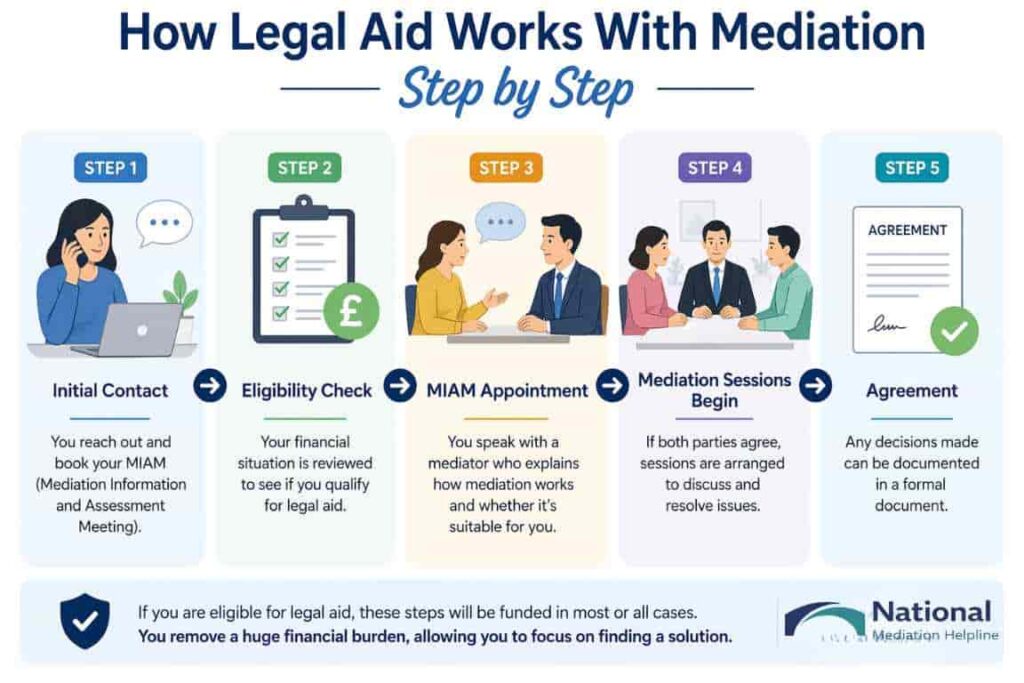
How Legal Aid Works With Mediation Step by Step
If you’ve never gone through the process before, it can feel unclear. In reality, it’s quite straightforward:
Step 1: Initial Contact
You reach out and book your MIAM (Mediation Information and Assessment Meeting).
Step 2: Eligibility Check
Your financial situation is reviewed to see if you qualify for legal aid mediation.
Step 3: MIAM Appointment
You speak with a mediator who explains how mediation works and whether it’s suitable for you.
Step 4: Mediation Sessions Begin
If both parties agree, sessions are arranged to discuss and resolve issues.
Step 5: Agreement
Any decisions made can be documented in a formal document.
If you are eligible for legal aid, these steps will be funded in most or all cases. You remove a huge financial burden, allowing you to focus on finding a solution.
Can Legal Aid Cover Mediation for Divorce?
Legal aid does pay for mediation, but there are some key points to be aware of.
Legal aid mediation does not generally cover the divorce proper (which would involve court fees or a solicitor dealing with the paperwork). However, here is what it can cover: mediation (sit down and work out things such as:
- Child arrangements
- Financial settlements
- Property decisions
The mediation generally occurs in parallel to the divorce, helping you manage the practical aspects of matters with less of an adversarial feel. Child Inclusive Mediation UK Maidenhead: Should Your Child Have a Voice?
It makes it feel a little more manageable and helps prevent long, drawn-out spats for many. If you think your situation isn’t eligible, it’s always worth checking — a lot of people assume that they aren’t eligible when really they are.

What Documents You Need to Get Legal Aid for Mediation
To apply for legal aid mediation, you’ll need to provide a few documents to confirm your financial situation. It’s nothing unusual, but having everything ready can speed things up.
Typically, you may be asked for:
- Proof of income (payslips or benefit statements)
- Bank statements (usually the last 2–3 months)
- ID (passport or driving licence)
- Proof of address
- Details of any savings or assets
If your situation involves domestic abuse, you may also need supporting evidence.
At National Mediation Helpline Maidenhead, we always suggest gathering these in advance so the process feels smoother and less stressful.
Legal Aid Mediation vs Private Mediation: Which Is Right for You?
While both modalities undergo the same mediation process, the cost varies.
Legal Aid Mediation
- If you meet the criteria, we will fund your subscription (wholly or partially)
- Lower financial pressure
- This is suited for those on a tighter budget
Private Mediation
- Paid for by the people in question
- More flexibility in scheduling
- No eligibility requirements
In fact, just because one person is granted legal aid mediation does not mean the other party cannot be helped with reduced or no-cost modules in their process (or portions of their hearing). What Is Property Division Mediation? A UK Maidenhead Guide
So, which is the right choice? That depends on you—but mediation, funded or private, always has a set goal: to reach practical, fair outcomes.

Can Legal Aid Help With Mediation for Child Arrangements?
Yes, and this is one of the most common areas where legal aid mediation is used.
If you’re trying to agree on arrangements for children—such as where they’ll live, contact schedules, or schooling—legal aid mediation can help cover the cost of mediation sessions.
These discussions can be sensitive, so having a neutral mediator makes a big difference. It keeps conversations focused and helps avoid unnecessary tension.
At National Mediation Helpline Maidenhead, we often see how mediation helps parents move from disagreement to workable solutions that prioritise the child’s wellbeing. What Is Online Mediation? A Complete UK Maidenhead Guide
Can You Get Legal Aid for Financial Mediation?
Legal aid can also apply to financial mediation, especially in cases linked to separation or divorce.
This might include discussions around:
- Dividing savings or assets
- Property arrangements
- Ongoing financial support
However, eligibility still depends on your financial situation. If you qualify, legal aid can cover the cost of working through these issues with a mediator.
Sorting finances can feel complicated, but mediation allows both sides to talk things through in a structured, balanced way.
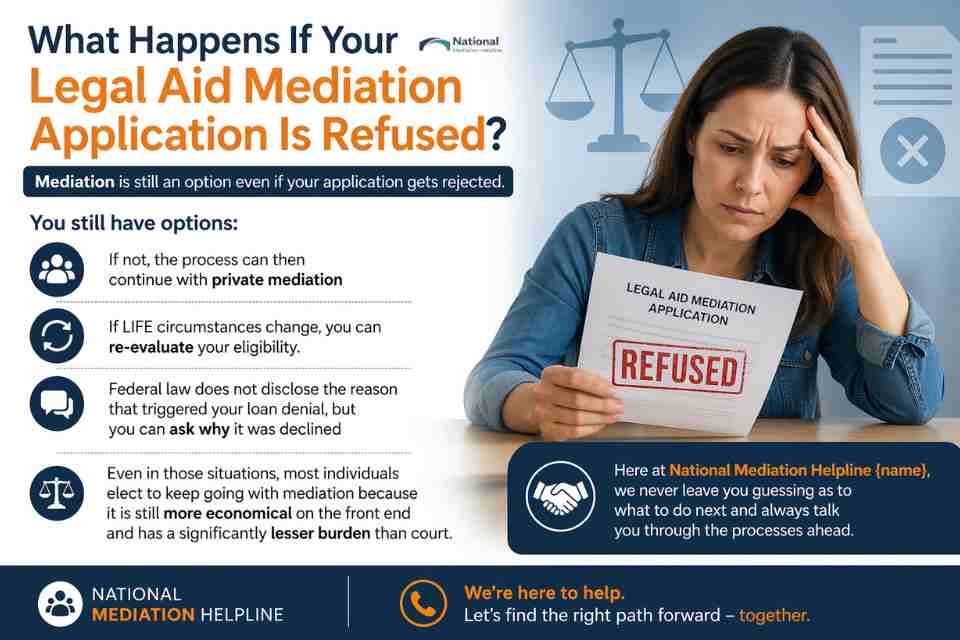
What Happens If Your Legal Aid Mediation Application Is Refused?
Mediation is still an option even if your application gets rejected.
You still have options:
- If not, the process can then continue with private mediation
- If LIFE circumstances change, you can re-evaluate your eligibility.
- Federal law does not disclose the reason that triggered your loan denial, but you can ask why it was declined
Even in those situations, most individuals elect to keep going with mediation because it is still more economical on the front end and has a significantly lesser burden than court.
Here at National Mediation Helpline Maidenhead, we never leave you guessing as to what to do next and always talk you through the processes ahead.
Top 10 Tips to Improve Your Legal Aid Mediation Application Success
When you are filing for legal aid, a little preparation goes a long way:
- Keep documents updated
- Double-check your financial details
- Be truthful and factual with your application
- Provide complete bank statements
- Include all sources of income
- Don’t leave sections incomplete
- Demand a speedy comeback over any aftereffect requests
- Your submission copies
- If you do not understand something kindly make sure to ask questions
- Ask for guidance before submission where possible
If your application is prepared correctly, it can also provide you with a longer and less annoying experience and improve the chances of a grant. The Parenting Plan Mediation UK (Now Our Child’s Plan): The Crucial Guide to Avoid Legal Troubles
FAQs – Shuttle Mediation In the UK Maidenhead
Q: What is a MIAM/Does legal aid cover MIAMs Maidenhead?
A MIAM is your first appointment with a mediator. Legal aid generally pays for this in full if you qualify.
Q: Can one person get legal aid and the other not?
It can also be true that they still go to mediation. In some cases, the other folks have taken pg for taken.
Q: What is the time frame for legal aid mediation Maidenhead?
It really depends on your situation, but generally speaking, many issues are resolved in a handful of visits.
Q: After mediation, do I need to go to court?
Not always. Alternatively, you will negate the need for court altogether if you reach an agreement.
Q: Is mediation legally binding?
These can then become enforceable when they are made into a court order.
Q: I would like legal aid but want to apply on my own.
Of course, but most go via a third party or service like National Mediation Helpline Maidenhead to prevent complications.
For Further Information, please Call Us On 03300 101 029